| |
| |
October 27, 2026 |
|
  |
Another verticale of official and semi-independent Benromach
When we say ‘semi-independent’, we mean Gordon & MacPhail, who have also owned the distillery since 1993. Production resumed in 1998, exactly a hundred years after its foundation in 1898. I freely admit to preferring these post-1998 distillates to the pre-1983 makes, 1983 being the year D.C.L. closed the place. Right then, onwards and upwards… |
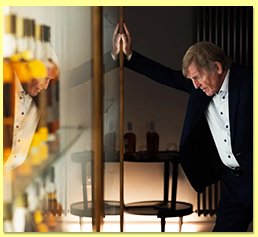
Sir Kenny Dalglish admiring some treasures at Gordon & MacPhail.
(Gordon & MacPhail) |
|
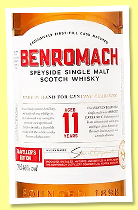
Benromach 11 yo ‘Traveller’s Edition’ (46%, OB, 1st fill cask, 2025) 
Let’s admit that ‘travellers’ aren’t always treated terribly well by whisky companies, particularly at airports. I’m not talking about Benromach! Here we have first-fill casks, probably a combination of bourbon and sherry… Colour: gold. Nose: perfect apéritif material, with all the DNA of contemporary Benromach and admirable restraint on the oak front, despite that ‘first fill’ mention. Above all, fresh walnuts and almonds, very lightly smoked and caramelised. A few drops of Maggi or malt extract seem to have found their way into the proceedings. Mouth: ashes, pepper, leather, tobacco, mustard, walnut liqueur, light brine, ras-el-hanout, then yet more pepper. Bags of personality and quite a hefty bitterness, albeit a lovely one. Finish: long, peppery, bitter, you could almost replace Tabasco or Worcestershire sauce with this rather boisterous little Benromach. Comments: something of the Dobermann about it, if you see what I mean.
SGP: 372 - 86 points. |
|
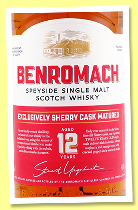
Benromach 12 yo (46%, OB, sherry cask matured, 2026)
‘Exclusively Sherry Cask Matured’, no less, perhaps a gentle kick in the shins for all those distilleries printing ‘sherry’ in enormous letters when they mean a finish or three years of re-racking. Colour: full gold. Nose: not far removed, just a little more walnut cake and pipe tobacco, with the rest much like the 11-year-old. Which we certainly aren’t complaining about, are we. Mouth: same comments, word for word. A little bitter orange joins the party, along with even more black pepper. Finish: much of a muchness. A touch of pine sap. Comments: six of one, half a dozen of the other.
SGP: 372 - 86 points. |

|
Benromach 2012/2026 (46%, OB, Taiwan Exclusive, first fill sherry hogshead, 150 bottles) 
Sorry, we only have a wee picture of the main label for now, we’ll put that right as soon as possible (yes, yes, of course we will) … |
Colour: dark amber. Nose: the previous one, only with more prunes, currants, fruitcake and very moist pipe tobacco, a few drops of armagnac and, above all, a pronounced Christmas cake character. Lovely touches of menthol and especially eucalyptus, perfect for some steam inhalations when you’ve caught a cold. Mouth: fairly massive sherry, packed with chocolate, tobacco and coffee, then prunes in armagnac and black pepper. Extremely classical, in that old-school Speyside style. Finish: long, at once jammy, mentholated and peppery. Prunes and orange marmalade rule the aftertaste. Comments: a profile which, we’ve always been told, goes down particularly well with our dear friends in Asia. Well played, then (and I suspect I have Asian ancestors myself, perhaps from the days of Genghis Khan…)
SGP:561 - 88 points. |
|
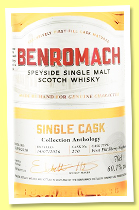
Benromach 16 yo 2010/2026 (60.1%, OB, LMDW Collection Anthology, Golden Promise, first fill sherry hogshead, cask #270, 260 bottles) 
This should deliver a few proper slaps… Thoroughly deserved ones, no doubt. Colour: deep gold. Nose: powerful, but elegant too, led by cedarwood, patchouli, tobacco, that eternal touch of mustard, fir wood, varnishes and apple tart drizzled with honey. Magnificent. With water: it draws in a little around fruit-and-honey bread. Things could be worse. Seriously, this is superb. Mouth (neat): incredible peppery, sappy, bitter power. I think we should fetch the water straight away… With water: an entire family of sultanas taking up residence in a cinnamon cake. Apricot jam wraps everything up and rounds it off. Finish: long, spicy yet gentle, yet spicy, yet gentle, yet… A more honeyed, smoky aftertaste. Comments: a Benromach in full battle dress. So far, we can hardly claim this vertical isn’t going well.
SGP: 662 - 91 points. |
|
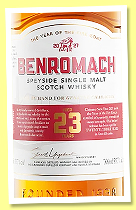
Benromach 23 yo ‘The Year of the Fire Goat’ (55.7%, OB, first fill bourbon and sherry, 2026)
I believe this baby won’t be officially launched until the very end of the year, but I could be wrong (who said ‘again!’, who?) The Year of the Fire Goat is 2027. Colour: deep gold. Nose: now this is more perfect than perfect. Cleaner than the others, more precise, more on nougat, honeysuckle, meadow honey, chen-pi, mandarin and citron liqueurs… Well, you get the picture. With water: it becomes almost ethereal, while recalling the intensely sweet wines of Egon Müller in Germany or Zind-Humbrecht here in Alsace. Let’s say Pinot Gris SGN Hengst with twenty years in bottle (a fresh memory, this one). Mouth (neat): exceptional bourbon. White pepper, orange, quince, mandarin, mullein syrup. The citrus fruits are fantastic, surprisingly so even. With water: would you believe me if I said this reminded me of early-1970s Clynelish? Finish: not that long, but with perfectly pure citrus. Lemon marmalade in the aftertaste, with a touch of pink pepper. Comments: this is getting awkward, we’re already at quite an altitude and still have three Benromachs to taste, all older, of course. We did say a verticale, didn’t we?
SGP: 651 - 91 points. |
|
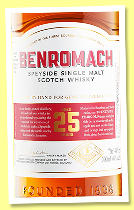
Benromach 25 yo (46%, OB, bourbon and sherry casks, 2026)
The latest arrival. Mind you, we’re dropping back to 46% vol., something we’ll have to allow for after the Goat Fur (the what?) Besides, we’re always wary of the death seat effect after a proper star such as that 23-year-old at over 55% vol. Colour: gold. Nose: lovely, of course, more classically Benromach, more coastal, taut and lemony, with more ashes, peat, wax, chalk… In short, less spectacular than the 23, certainly, but even closer to my personal tastes. Hey, it’s my ‘blog’, I’ll do and say what I like (LOL, as we used to say before Trump). Mouth: the most perfect demonstration of the validity of my personal theory about Scotch malt’s ‘main axis’. A reminder, from north to south: Highland Park, Clynelish, Benromach, Ben Nevis, Springbank. Here, spices, especially pepper, and salted citrus fruits, brined Italian-style, dominate this lovely picture, lively as an ermine in a hurry. Finish: long, more saline, maritime, lemony, and I swear a few oysters went past too. Comments: a relief, I confess, I was a little worried The Year of the Fur (come on) might have flattened it.
SGP: 452 - 91 points. |
|
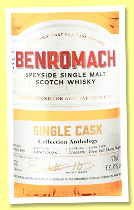
Benromach 26 yo 1999/2026 (53.8%, OB, LMDW Collection Anthology, first fill sherry hogshead, cask #21606501, 322 bottles)
First bit of good news, there are 322 bottles. Or rather, there were. You’ll also have noticed that this vintage comes from the year after the distillery restarted. Perhaps there was still a little trial and error period going on? I doubt it, but you never know… Colour: full gold. Nose: no, this is peatier, more coastal, waxier, almost more rubbery. Boot polish, new rubber bands, smoked almonds, charcoal, burnt pinecones, dried morels, a full ashtray… With water: practically Campbeltownian now. Mouth (neat): someone seems to have thought that taking lemons, peppering them and smoking them over fir wood might be an interesting idea. Bless that person. With water: back to basics, pepper, chalk, clay, and a certain dryness and bitterness from all those ashes. Finish: long and very dry. Comments: water needs handling carefully with slightly older malts from active wood, as it can heighten the feeling of tannicity. Now here, the citrus fruits keep things nicely afloat. Magnificent nose and palate without water, although water does tend to slightly upset the apple cart on the palate. In my humble opinion.
SGP: 572 - 89 points. |
Let’s finish with an ‘old Benromach’, if you will… |
|
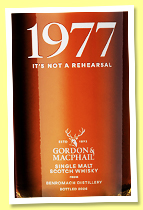
Benromach 1977/2026 ‘It’s not a Rehearsal’ (46.7%, Gordon & MacPhail, Sir Kenny Dalglish’s Vintage Moments, first-fill sherry hogshead)
Benromach’s style before the 1983 closure was different from the post-1998 ‘G&M’ profile, let’s say less distinctive, certainly less smoky, less coastal, less nervous, less thick and less textured too. Between ourselves, I even wondered whether we ought to have tasted this little 1977 first, ahead of the very lovely ‘modern’ 11-year-old. But a verticale is a verticale, as Monsieur de La Palice would have said… Colour: gold. Nose: phew, still very lovely indeed, with that light mustard already present, tarragon, liquorice wood, ripe plums, walnuts and even delicate touches of fennel seed. In short, it’s holding its own perfectly well so far. Mouth: very bitter, but these are magnificent bitters, chiefly Seville orange, green walnut, resin, lemon peel, then a whole host of distinguished, elegant peppers. Will you forgive me if I mention touches of tequila too? Did Sir Kenny ever play against Mexico? Finish: long, more antiseptic, herbal, on fruit skins, green walnuts, grapefruit… Yet everything is perfectly synchronised. Almost a surprise, really. Comments: I’m afraid you’ll think we’ve made all this up, but in memory of Frank Zappa, Miles Davis and John Coltrane, I certify with a light heart and a clear conscience that we haven’t. At all.
SGP: 461 - 91 points |
I’m beginning to think the differences between ‘old’ and ‘new’ Benromach aren’t quite as pronounced as I’d suggested. I shall therefore immediately withdraw from the world to an ashram in Tibet to meditate on the matter. I reckon I’ll need at least seven years (naturally). But what a session indeed. See ya. |
| |
October 26, 2026 |
|
|
Another little trio
of Jura
As you may know, we always enjoy tasting Jura, as the malt often springs surprises, sometimes delightfully odd and sometimes rather magnificent. Except, perhaps, for the official wine-finished NAS versions bottled at 40%, which we shall probably manage to avoid today... Or shall we… |
 |
|
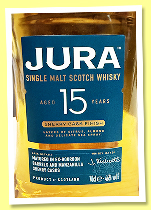
Jura 15 yo (46%, OB, sherry cask finish, 2026)
The last 15-year-olds we tasted, the ‘Paps’, had been finished in pinot noir, cabernet-sauvignon and Barolo. That was more than 15 years ago, and they hadn’t exactly set the Hebrides alight (WF 73 to 78). This time, however, it’s a manzanilla finish, which is quite another matter than red wine! I mean, in whisky… Colour: pale gold. Nose: wet stone, limestone, I was almost going to say albariza, porridge, green walnuts, slightly sweet-smelling seaweed… It does feel a little like a concoction, admittedly, but I think it works. We love manzanilla at WF, even in our whiskies. Mouth: lovely tension, very saline and delightfully bitter, with green walnuts returning alongside ashes and chalky notes, then a little candied lemon zest to round things off slightly, although there’s also more and more green pepper. Finish: long, holding its course. A little suggestion of peat in the aftertaste, but that may be the manzanilla. Comments: charming and clever! But we’re still waiting for a Jura with a Jura finish (vin jaune, ha).
SGP:352 - 86 points. |
|
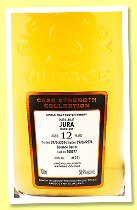
Jura 12 yo 2014/2026 (58.9%, Signatory Vintage, Cask Strength Collection, bourbon barrel, cask #700377, 211 bottles)
This ought to be proper Jura through and through. Colour: pale gold. Nose: very, very dry, with plenty of varnish and even touches of acetone, before custard with acacia honey gradually begins to coat it all. There’s also a slightly earthy side, which certainly recalls the limestone mentioned above. With water: quite surprising, we’re staying in the same taut, earthy vein as the official 15-year-old, with that little touch of mustard we sometimes unearth (right) in Jura... Mouth (neat): very lively, on pepper and vanilla, the pepper almost stinging your lips and the tip of your tongue. Unless that’s the high strength. With water: much fruitier now, but that mineral, almost prickly character remains. Finish: long and peppery, with a few liquorice allsorts in the background. Comments: a real Jura with character, more energetic than the official bottling but at the same (high) level for me.
SGP:562 - 86 points. |
|
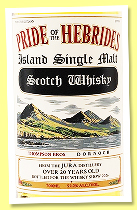
Jura 20 yo 2006/2026 ‘Pride of the Hebrides’ (52.2%, Thompson Bros. for The Whisky Show London, 2nd fill barrel)
The old G&M labels continue to inspire the younger top-flight independent bottlers, which, as they say, is probably the sincerest form of flattery. Or tribute. Colour: gold. Nose: this is a peated version, very heavily peated indeed, in a pure, very mineral style, with just touches of grilled bacon in the background and a little Ardbeg-like tar. With water: an abundance of flint and basalt. Are there volcanoes on Jura? Are the Paps ancient volcanoes? Having checked, no, not at all, for volcanoes you need to head to Skye or Mull. Some very lovely grapefruit too. Mouth (neat): very clean, peppery, very smoky, again on bacon but also Korean-style smoked oysters. Touches of horseradish and kimchi, since we were talking about Korea. With water: superb, saline, on a sort of mixture of gherkins and peppered lemon. Finish: long, fresh, peppery and lemony, and even medicinal (antiseptic). Comments: a peated Jura! With a little wave to Dawn, Dave and Sukhinder, my fellow conspirators in the ‘three blind men’ masterclass held each year at The Whisky Show in London. As it happens, we had a Peated Jura this year that was very close to this one. Not easy to identify blind… In any case, it’s rather magnificent and, in a way, something of a synthesis of the three distilleries on Islay’s south coast. Okay, four. Okay five, very soon, apparently…
SGP:467 - 90 points. |
 Check the index of all Jura we've tasted Check the index of all Jura we've tasted
|
| |
October 25, 2026 |
|
|

|
|
A word of caution
Let me please remind you that my humble assessments of any spirits are done from the point of view of a malt whisky enthusiast who, what's more, is aboslutely not an expert in rum, brandy, tequila, vodka, gin or any other spirits. Thank you – and peace! |
A few Armagnacs for this Sunday |
Lovely houses, lovely grape varieties, lovely spirits… And since France is in a complete muddle at the moment, which we hope is merely a Schumpeterian phase, we shall taste all these armagnacs at random, in a glorious shambles… which we therefore hope will prove creative. Right then, we need cheering up, so we shall take absolutely no chances with today’s apéritif… |
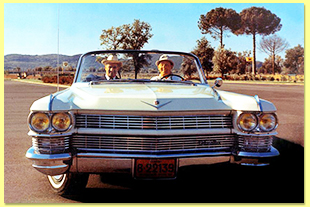
Bourvil and De Funès in 'Le Corniaud'
(1965) |
|
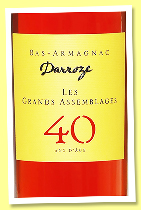
Darroze 40 yo ‘Les Grands Assemblages’ (43%, OB, Bas-Armagnac, +/-2026)
We tasted the entire Grands Assemblages range around 2015, and this light, bright and cheerful 40 yo impressed us quite a bit (WF 88). Here is a new bottling… Colour: amber. Nose: wafts of pine sap and menthol cigarettes, then a little propolis and myrtle, plenty of furniture polish, and ultimately rather little fruit on the nose. Mouth: the fruit turns up here (cooked peaches), but is soon overtaken by liquorice, pine sap, black pepper and dark tobacco. Nevertheless, everything remains beautifully balanced, almost miraculously so. Well, no, I’m sure they did it on purpose (ha!) Finish: medium in length, dry and rather woody, but since that takes us towards dark chocolate with a touch of salt and smoke, all is well. An amusing kirsch-like touch in the aftertaste. Comments: no desire whatsoever to change the score.
SGP:461 - 88 points. |
|
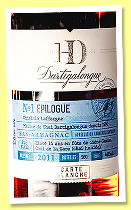
Dartigalongue 14 yo 2011/2026 ‘N°1 Epilogue’ (46%, OB, Bas-Armagnac, cask #A12, 560 bottles)
Baco and ugni blanc. Colour: amber. Nose: lovely metallic touches to begin with (grandmother’s old coin purse), followed by dried herbs, notably hay and parsley, then chocolate, candied oranges, digestive herbal teas (armagnac is always a digestif) and raisins soaked in rum. Middle Eastern pastries flavoured with orange blossom seal the deal. Mouth: we are closer to the grapes here, but also to spices, notably ginger and pepper which, together with salted candied orange peel, give the whole thing quite a feisty character, ultimately closer to a marc than a fine. I would hardly have protested had you told me this was marc de Bourgogne or du Jura. Finish: long, still with that same feistiness. Marc, pear, and even old genever. Comments: a very surprising cask, far removed from classic armagnac, which is probably one of its main virtues. We like it very much.
SGP:462 - 86 points. |
|
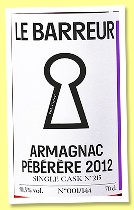
Pébérère 2012/2026 (50.3%, Le Barreur, Ténarèze, cask #215, 144 bottles)
Baco and ugni blanc again. We have already tasted some very fine Pébérère from the previous incarnation of ‘Le Barreur’, ‘Le Passeur’. Colour: amber. Nose: I promise you, this reminds me of wood-aged gewurz marc. At least to begin with, as this baby takes its time opening up, but if you enjoy Bergman’s films, you should like it. Sultanas, then herbal teas, then muscat-like touches, then orange blossom, then natural rubber (new wellies), then roasted peach… Etc. Mouth: it took its time on the nose, but it shoots across the palate like an arrow. Pink grapefruit, lemongrass, goji berries, a light latte, crushed black pepper. Finish: long, a little more rustic, earthy, tart and slightly spicier (pepper, very dark chocolate), but we like that country character. Comments: did someone say ‘terroir’?
SGP:461 - 87 points. |
Another Ténarèze, please… |
|
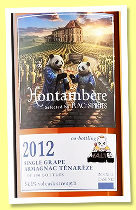
Hontambère 2012/2026 (54.1%, Les Tontons Maltés, Baco, Ténarèze, cask #N12, 100 bottles)
According to the label, pandas (!) seem to have been involved here. Chinese soft power at work again? Colour: amber. Nose: very clean and direct, on peanut butter, praline and apple tart drizzled with honey and sprinkled with cinnamon. With water: a little fresh rubber, angelica and pears. Mouth (neat): we find some very modern spices, almost a bourbon-like character, rye, ginger… And Williams pear. With water: little change, apart from the arrival of touches of cooked quince. Finish: medium in length, still spicy, nutmeg, cinnamon, ginger, chocolate… Comments: a very ‘American’ Ténarèze, we almost expect Bourvil and De Funès to turn up in a 1960s Cadillac. For those who know what all that means…
SGP:551 - 85 points. |
|
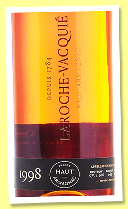
LaRoche-Vacquié 1998/2025 (49%, OB, Haut-Armagnac, #63)
Here we are in Lectoure, with colombard and ugni blanc, in an appellation that had almost been forgotten but seems to be rising from the ashes, thanks to a few energetic and determined houses. Colour: amber. Nose: I love this! Very classic, very balanced, on double-cream milk chocolate with sultanas and praline pieces, plus hazelnut liqueur and, while we’re at it, a few drops of Bailey’s Irish Cream from a great vintage (eh?) It reminds me of that cocktail which was all the rage in my very recent youth, the Alexander. Mouth: everything is spot on, the balance, the oranges, the peaches, the liquorice, the violets, the coffee, the tobacco. To tell the truth, there isn’t all that much to say, it is so classic. Except that there is a little cognac-like side to it all the same. Finish: fairly long, with no major changes. Comments: almost an armagnac designed by AI, everything is so perfect and neatly in place. We are joking, of course, and almost ashamed of ourselves.
SGP:551 - 89 points. |
|
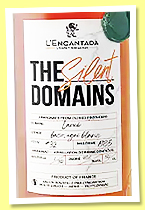
Domaine Laoué 1985/2026 (48.6%, L’Encantada, The Silent Domains, for LMDW Les Anthologistes, Bas-Armagnac, cask #32)
Baco and ugni blanc, from an estate that has been silent since around 2010. Colour: amber gold. Nose: a superb nose, on varnish, morels, truffles and verjuice vinegar. Very distinctive, and it would probably be a star in a great chef’s kitchen, but we would rather drink it straight, wouldn’t we. Mouth: I love it. Those mushrooms and splendid vinegars are back, but also black garlic (!) and coffee. Superb oak. Finish: long and very balsamic. Comments: sometimes a spirit just ‘clicks’, not necessarily for any specific reason. This is one of those.
SGP:462 - 91 points. |

|
Laterrade 20 yo (42.4%, Poh! Games, Spirits Adventure, Armagnac, 2026)
A blend of several casks. The bottle’s get-up is completely loco, and we love it (perhaps because we are sometimes rather a little loco ourselves). Colour: full gold. Nose: gentle yet lively, fruity yet balanced, woody but not too much, herbaceous but only a little, vinous but very moderately so… Above all, lovely, with some very ripe banana skin. Mouth: a mirror image of the nose, with an additional slightly acetic side that works perfectly. And is less dominant than in the magnificent Laoué. Finish: not very long, a little woody and increasingly wild and rustic, but what can we say, we are in Armagnac country. Comments: a lovely little creature.
SGP:551 - 87 points. |
|
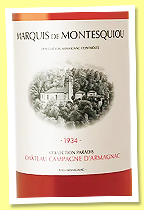
Marquis de Montesquiou 1934/2026 (41%, OB, Collection Paradis #2, Bas-Armagnac)
From the recently renovated Château Campagne d’Armagnac. 1934 was a great vintage in many French regions, as the forebears of many friends from abroad could have testified, having, let’s face it, rather emptied the cellars five to ten years later. We can hardly blame them for that. Colour: americano coffee. Nose: ultra-classic, currants, prunes, sweet wines, rancios, Rivesaltes, fig jam… Mouth: let’s be honest, many old armagnac vintages are only really of interest as birthday presents. But that is not the case here, certainly it is rounded and classic, but the little beast still has plenty to say, with fir needles, bud liqueur, currants, chocolate, and even a few dates stuffed with marzipan. Finish: this is obviously the slightly trickier part, but far from collapsing, it acquits itself with honours. We would happily have a second glass, so it has remained… moreish. Comments: well, we have to detach ourselves from all the mental images a spirit can conjure up, and in a case like this, that is a huge part of the whole experience. You understand?
SGP:341 - 86 points. |
| |
October 23, 2026 |
|
|
A surprising Lowlands trio
Let us say that today we shall be tasting two independent bottlings from a Lowlands distillery very seldom seen among the independents, followed by another Lowlands malt rarer still than a French far-left politician with two brain cells still talking to each other. |
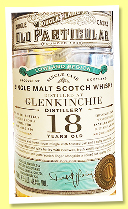
|
Glenkinchie 18 yo 2008/2026 (48.4%, Douglas Laing, Old Particular, refill hogshead, cask #DL201010, 181 bottles) 
Colour: gold. Nose: very much Glenkinchie as we imagine it, light, fruity, pleasant and without any grand ambitions, with marshmallows and icing sugar, plus lemon and clementine liqueurs. Mouth: the same, but tauter and more lemony, with a reassuringly grassy side, although the overall profile does rather make you want to add ice cubes. And save it for summer, which now runs from early March to late October in these parts. Finish: medium in length, with apple, pear, pineapple, lemon and cane syrup. Comments: we cannot say it sets the world on fire, but nor can we say it is bad, not at all, quite the opposite. Rather the equivalent of a BBC documentary about yak farming in Outer Mongolia. Hugs to our Mongolian friends! (But not to the yaks, let us not get carried away).
SGP:431 - 80 points. |
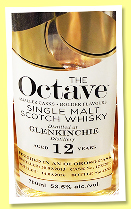
|
Glenkinchie 12 yo 2013/2026 (53.5%, Duncan Taylor, The Octave, oloroso finish, cask #12382875, 95 bottles) 
Curious to see what this micro-bottling of souped-up young ‘kinchie will deliver… Colour: gold. Nose: a very entertaining composition of caffè latte, fudge, praline and walnut liqueur. The tiny cask is probably playing disc jockey here. With water: a little mild ale, a little sanity. Mouth (neat): touches of crystallised ginger, caramel, angelica, ginseng, fresh turmeric… In short, the cask really is the boss. With water: mint tea and bitter almonds. Finish: medium, somewhat dominated by ginger. Comments: please remind me which distillery this was from? Anyway, it is good, just not incredibly memorable.
SGP:441 - 79 points. |
And so, our guest of the day, also from the Lowlands… |
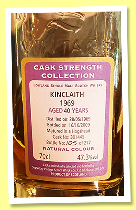
|
Kinclaith 40 yo 1969/2009 (47.3%, Signatory Vintage, Cask Strength Collection, hogshead, cask #301445, 217 bottles)
A few words are in order, as I have just noticed that we have already tasted, ta-da, nine different Kinclaiths, and are therefore about to taste our tenth expression (hurrah!). Anyway, Kinclaith operated only from 1957 to 1975. It was not really a standalone distillery, but a small malt production unit installed within Glasgow’s Strathclyde grain distillery, as was done in several places at the time (Ben Wyvis etc.). Naturally, it is very rare nowadays and almost forgotten. Our turn to play, I would say, with thanks to Andrew S., from Pitlochry… Colour: gold. Nose: incredibly fresh, very much on apple tart, or pear, or quince, or mirabelle plum tart, with a hint of cinnamon and three drops of acacia honey. A few touches of elderberries too, which will inevitably remind us of Monty Python and the Holy Grail. Mouth: frankly, really very good, with baked apples drizzled with honey and dusted with cinnamon. Touches of chardonnay, white pepper and a hint of horseradish to give everything a little lift. Finish: fairly long, maltier, with more peppery herbal teas and peppermint essential oil. Comments: I would not claim that we can describe Kinclaith’s flavour profile with any precision, but it is part of Scotland’s history all the same. What is more, at forty years of age, this baby has sent the young Glenkinchies straight back to Malt Primary School. Without breaking a sweat.
SGP:551 - 87 points. |
| |
October 22, 2026 |
|
|
Glendronach 1991 ex-puncheon, twice |
These early-1990s Glendronachs have such a reputation that we can probably get straight down to business, without any unnecessary waffle… Oh, just one thing, the second will be my 23,000th whisky tasted, and our 29,750th spirit across all categories together with our dear Angus. Next year, then, we shall be celebrating both Whiskyfun’s 25th anniversary and our 30,000th tasting. If we make it that far… |
 |
|
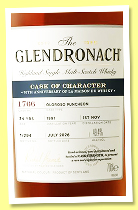
Glendronach 34 yo 1991/2026 ‘Cask of Character’ (49.4%, OB, 70th Anniversary of La Maison du Whisky, oloroso puncheon, cask #1766, 294 bottles)
We love the wonderfully elegant simplicity of these labels. Colour: mahogany. Nose: chestnut cream lightly flavoured with coffee, beef jerky, fir honey, broom and pansies, chocolate truffle and a family-sized box of marrons glacés for Christmas. Unfortunately, all this is quite irresistible. Mouth: chocolate with prunes, armagnac, dark tobacco and mocha, followed by freshly ground pepper. I don’t think there’s much need to add anything, except that this very dry character is rather sublime and quintessentially Jerez. Finish: long and, curiously, sweeter, more rounded, almost honeyed. But the armagnac side (Ténarèze) soon brings us back to our senses. Comments: the season of truly great malts is well and truly open! Here at WF, we could almost call it the shooting season. Rest assured, we use a trusty Royal Side-by-Side from Holland & Holland.
SGP:561 - 91 points. |
|
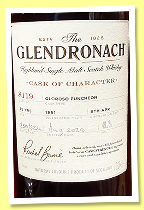
Glendronach 35 yo 1991/2026 ‘Cask of Character’ (49.7%, OB, oloroso puncheon, cask #8119, 324 bottles)
I must say it again, oh, those lovely labels! They convey the only message that matters: ‘it’s what’s in the bottle that counts’. Colour: mahogany. Nose: so close! Perhaps just a little rounder, more ‘easy-going’, then very slightly more fermentary, with surprising touches of Belgian Trappist beer. The one beginning with a W., the 12, of course. Mouth: same impression, very close, a little sweeter and fruitier, and consequently a shade less marked by Gauloise tobacco and our grandfather’s Ténarèze. In any case, the whole thing holds together spectacularly as we gently move towards honey-cured ham or even molasses. Finish: long, coffee and kirsch, tobacco, prunes, etc. Comments: as we said, our gun has two barrels and its aim is impeccable.
SGP: 561 - 91 points. |
| |
October 21, 2026 |
|
|
Dalmore, vertically
We thought that, after the seven superb Taliskers we had yesterday, we might try another little verticale, this time with a malt that is perhaps Talisker’s exact opposite in terms of style. Let us start with two young independents…
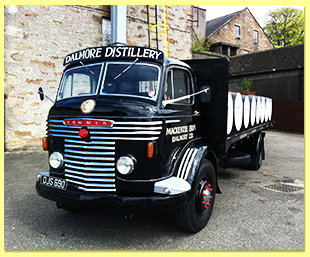
(WF Archive, 2013) |
 |

|
Dalmore 12 yo 2014/2026 (46%, Signatory Vintage, Un-chillfiltered Collection, first fill sherry butt finish)
Colour: deep gold. Nose: well, we are not very far from the style of the OBs, with raisins, candied orange, chocolate and very faint metallic touches (old copper coins). That last part reminds us of the little Scottish joke about copper wire having been invented by two Highlanders fighting over a penny. We love them dearly, so we hope they will forgive us! There are also some very classic touches of walnut liqueur. Mouth: classic Dalmore indeed, with three tonnes of Jaffa cakes and a little peppery nip. Finish: long, with peppery raisins returning to the fore. Comments: excellent, with very classic sherry, ultimately just a little less rounded than the official bottlings of similar ages.
SGP:561 - 85 points. |
|
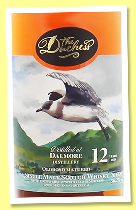
Dalmore 12 yo 2013/2025 (56.2%, The Duchess, oloroso hogshead, cask #9002541)
We are expecting something similar, despite the much darker colour. Colour: copper gold. Nose: actually, this is drier, more on slightly burnt walnut cake and toasted malt. Kougelhopf. With water: faint notes of burnt wood and rubber. All rather French, particularly at the moment, if you see what I mean. Mouth (neat): this time we are close, with just some touches of grilled meat, hamburger-style. The rest is shared between bitter almond and dark chocolate, with hints of juniper and clove. With water: we find ourselves close to the 2014, only a little more bitter. Chocolate with 75% cocoa. Finish: long, with green pepper making an appearance and that juniper and clove duo still going strong. Comments: a lovely, very dry character, with ultimately rather little orange.
SGP:461 - 85 points. |
On to the official bottlings… |
|
|
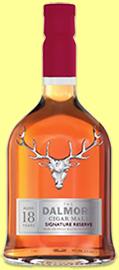
Dalmore 18 yo ‘Cigar Malt Signature Reserve’ (46%, OB, 2026)
A brand-new, older version of the famous Cigar Malt, which, as we have observed in the past, can also manage perfectly well without a puro of any kind. This is quite a marriage too, involving ex-bourbon, Matusalem sherry, cabernet sauvignon, cabernet franc and marsala casks. Nothing less… We could insist on knowing the exact provenance of the casks, but we shall not bother the most excellent Richard P. Colour: deep gold. Nose: very oddly, considering the quantities of wine involved, we find this baby maltier, rounder too, and above all more on those proverbial oranges and the marmalades made from them. There is also a lovely earthy side, even touches of dried morels, followed by dark turrón and a little toffee. Mouth: once again, the oranges dominate, especially after the young indies. Peppery zest, even a touch of bergamot, refined sherry, and a very well-controlled vinosity, much to our delight. Black pepper also makes quite an appearance, accompanied by that famous, unmistakably Dalmorian dark chocolate. Finish: fairly long, now drier, with pepper, dark chocolate, espresso… Comments: these recent Dalmores are drier and less loaded with fruit than the versions from… er, 40 or more years ago (black labels). Still excellent, though.
SGP:461 - 87 points. |
Back in time we go, then… |
|
|
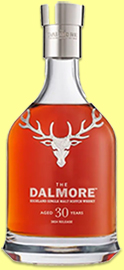
Dalmore 30 yo ‘2024 Release’ (43.8%, OB)
Here we have a finish in old tawny and colheita port casks from Graham’s, which rather announces itself through this baby’s colour… Colour: red peach. Nose: let us say it straight away, this is one of the finest port finishes we have had the pleasure of nosing in recent years. We find the cooked peach suggested by the colour, then prickly pear, Dalmore’s signature orange, and this time rather more milk chocolate. Heather honey and a few drops of old gewurztraminer complete this lovely, wonderfully fresh picture. Mouth: let us admit it, this is rather irresistible, with ripe mango to begin with, then sweet paprika mingling with quince and flower jellies. A tiny piece of rose-flavoured Turkish delight. Finish: not all that long, but fresh and fruity, carried by honey and very ripe peach. Comments: only the strength might have been a little higher, to prevent the finish from fading just a touch. But, as we sometimes say, there is a remedy for that: have a second glass. Avoiding a third, naturally…
SGP:6541 - 90 points. |
|
|
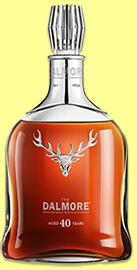
Dalmore 40 yo ‘2024 Edition’ (42%, OB, Gonzalez Byass Matusalem oloroso finish)
This is the 2024 version, others having appeared before it, such as the 2018, which we rather liked. However, a quick search through our archives, across all distilleries, would suggest that we generally prefer the 30 or 35-year-olds to the 40-year-olds. But, as ever, taste is personal… Colour: dark amber. Nose: to tell the truth, it is not so very different, just even more floral and fruity, with still more cooked peach, peonies, mullein flowers, woodruff, very ripe figs, praline and currants. No, this really is tremendous. Mouth: the art of proving ourselves wrong. It is certainly drier, more chocolatey, perhaps even very slightly grippy (dry walnut wine), but this stroll through Jerez is simply wonderful. Naturally, there are walnuts in abundance, along with bitter oranges and little touches of bark and toasted pine nuts. Finish: not all that long, but that is solely down to the slightly modest strength. Walnut chocolate, with a tiny salty touch and Ethiopian mocha. Comments: this baby whisks you off to Andalusia in greater comfort, and with a more reliable timetable, than easyJet. Hmm, take that comparison for what it is worth…
SGP:651 - 91 points |
|
|
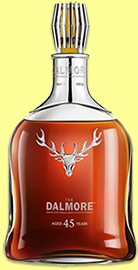
Dalmore 45 yo ‘2024 Edition’ (40%, OB)
This baby comes in a Baccarat crystal decanter, so made not far from Château Whiskyfun, just over the mountains (the Vosges, that is). The 40% is admittedly a little frightening (so to speak), but with Dalmore there is always the chance of a wonderful surprise. Note that we have never tasted a Dalmore 45 before. This one was finished in cabernet sauvignon (why not) and then tawny port (why not). Colour: dark amber. Nose: the typical style is there, imagine milk chocolate (double cream) containing fragments of praline, dried strawberry, dates and pink peppercorns. Then come tarte tatin, lingonberries and blueberries, and a very faint menthol note that somehow lifts the whole thing. Lovely freshness, with surprising liveliness at this advanced age. Mouth: the oak is more prominent, inevitably, with rather dominant tobacco accompanied by ground coffee. It remains lovely, but the 40% does little to sustain its verve or prevent a slight sense of frustration on the palate. Finish: fairly short, very much on black tea, coffee and chocolate, the latter dark as well. Fortunately, there is a little chestnut honey in the aftertaste. Comments: the 40-year-old, all the way! The 30-year-old too.
SGP:461 - 88 points. |
| |
October 20, 2026 |
|
|
Talisker, vertically
Shall we say we’ll be wandering between 1978 (Talking Heads, baby) and 2012, does that suit you? With two or three genuine stars from the Isle of Skye… |
 |
|
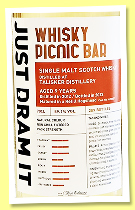
Talisker 9 yo 2012/2022 (59.1%, Whisky Picnic Bar, refill hogshead, cask #HL18807, 209 bottles)
They had added ‘Just Dram It’ in large letters on the label. May we taste it all the same? We’d already had an excellent 2011 from the same stable. Colour: pale white wine. Nose: precisely chiselled, with smoked oysters, seaweed, iodine and a little salted butter. Wonderfully elemental stuff. With water: salted butter caramel! Incredible… Mouth (neat): a little brutal, with the proverbial pepper, plus salt, lemon and slightly bitter seaweed. Then antiseptic and ashes. With water: much the same, plus a sort of very feisty green peat. Finish: long, intensely salty, practically seawater. Comments: probably a little immature, but then again, that allows us to get very close to the distillate. And what a distillate! The cask was little more than a footnote here.
SGP:466 - 89 points. |
|
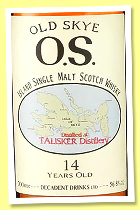
Old Skye 14 yo (56.8%, Decadent Drinks, Refill HHD + 1st fill Sherry Butt, 2026)
We don’t know whether Angus and his gang used the name ‘Old Skye’ because they weren’t allowed to call this baby ‘Talisker’, or whether it was a bit of whimsy, or a desire for consistency with the ‘Old Orkney’ range and its successors. But does it matter? Oops, I’ve just noticed that they did indeed put ‘Talisker’ on the label, so I’ve been talking nonsense again. Colour: gold. Nose: old copper pots, saltpetre, slag, then old walnuts and nocino. Much gentler than the 2012, although that could still change. With water: magnificent! It feels as though we’re facing an old manzanilla with a little more wood than usual. We could call it ‘special new criaderas’, if we weren’t afraid of looking ridiculous. Mouth (neat): an excellent peat + sherry combination that works this time, with plenty of leather, tobacco and bay leaf, plus surprising notes of pink grapefruit and tapenade. With water: it tightens up, moving towards very salty mustard, samphire and green walnuts. Finish: long, saltier than seawater. Pipe tobacco afterwards. Comments: I think this was a daring exercise, but they’ve pulled it off perfectly. Quite a tightrope act.
SGP:366 - 91 points. |
|
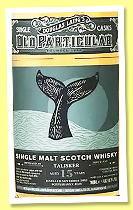
Talisker 15 yo 2010/2026 (59.7%, Douglas Laing for LMDW ‘Les Anthologistes’, hogshead, cask # 714514)
Colour: pale white wine. Nose: very narrow, almost constricted, yet magnificent, with tincture of iodine, flint and green apple. Pinpoint precision. With water: smoked barley, lots of smoked barley. Bread baked in a wood-fired oven, with ashes even inside it. Mouth (neat): amusing notes of Williams pear remind us that, after all, this Talisker isn’t old. And if it is, the cask remained as silent as the grave. In fact, it’s superb, almost embarrassingly so already. Indeed, really. With water: seawater, apples and pears, green pepper, mercurochrome. Finish: it becomes almost gentle, almost civilised. Barley, ashes, pear. Not all that much pepper. Comments: another wonderful young Talisker. Young in the glass, at any rate, with a proper ‘mezcal’ effect. I know what I mean.
SGP:556 - 91 points. |
|
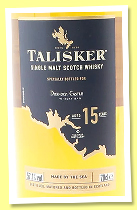
Talisker 15 yo (57.1%, OB for Thompson Bros., Dornoch Castle Whisky Club Exclusive, refill hogshead, second-fill Port finish, 250 bottles)
Securing an official Talisker to offer is quite a coup, even these days, when allocations are becoming a somewhat… ahem, old-fashioned concept. Granted, the port is a little worrying, but it was refill, and only for four months… Colour: chardonnay. No faded rose, no partridge eye, no onion skin, no ripe apricot. Phew. Nose: yes, well, it’s Talisker with a tiny touch of strawberry purée, much less than in a Strawberry Daiquiri. In short, it works, Skye’s peaty spirit keeps the upper hand. With water: it doesn’t change much. Mouth (neat): even less port, or at least strawberry, and to be completely honest, had I not known this was a port finish, I might not have spotted it. Of course, once you know, you can taste it, that’s how our brains work, which is why so many mammals are better than us. In this respect, I mean. With water: the malt takes the lead, while cherry and Timut pepper partly replace the strawberry. Finish: long, with more green pepper alongside the pink pepper. Salty aftertaste, as expected. Comments: a very fine variation on Talisker, softened a little but far less disconcerting than expected.
SGP:655 - 87 points. |
Hang on, since we’re on the subject of 15-year-olds… |
|
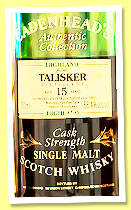
Talisker 15 yo 1978/1993 (56.4%, Cadenhead, Authentic Collection)
As usual, the label specifies that this baby was matured in an oak cask, which happens to be our favourite running joke. You’ll tell me that technically, although not legally, it could have been chestnut or even acacia, both used for transporting certain wines, but it’s been centuries (right) since I last saw any in Scottish warehouses. But enough nonsense… Colour: bronze mahogany. Nose: this is sherry. And it’s magnificent, with competition-standard walnut cake (Mrs Whiskyfun makes an excellent one, glazed with gewurz marc), then tobacco and sublime notes of mandarin, clementine, bergamot, citron, kumquat, well, you get the idea. Splendid. With water: forget it, this is just too beautiful. The camphory side is sublime, and the tobacco is a very grand cru from the Vuelta Abajo. Mouth (neat): grandiose, salty, with intergalactic sherry, hoisin sauce, competition-standard nusswasser, balms and oils, precious chocolate and equally precious coffee. What’s spectacular is how completely everything has come together, melded and mingled like Jagger and Richards (and Mick Taylor) in Wild Horses. Right. With water: utterly sublime chocolate. Finish: likewise, utterly sublime chocolate. Comments: holy featherless crow, what a Talisker and what a sherry!
SGP:465 - 94 points. |
Let’s take the opportunity to stir things up a little … |
|
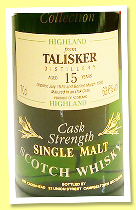
Talisker 15 yo 1979/1995 (63.6%, Cadenhead, Authentic Collection)
Yeah… Colour: pale white wine. Possibly the refill counterpart to the previous heavy sherry. Nose: that feeling of having opened a tin of sardines with lemon and olive oil, or of strolling around a fishing port, Douarnenez, Agadir, Essaouira, Port of Palm Beach, Vigo, Zamboanga (spot the odd one out) … I’ve rarely found so many sardines or anchovies in a whisky. With water: medicinal notes arrive, eucalyptus, lime, smoked porridge… Mouth (neat): incredible, simply incredible, even at 63.6%, or probably a little less after thirty years in bottle. What a maritime, fishy beauty! With water: forget it, this is simply wonderful. Finish: long, almost gentle, but with sumptuous salinity. Comments: a work of art, with something of Brora about it. And I’m convinced those thirty years in bottle have done it a world of good, softening the peat rather than dulling it.
SGP:464 - 94 points. |
Well, it would have been vulgar to give these 1978 and 1979 CADs different scores, especially as they came from extremely different casks. Still, things could prove tricky for the last whisky in this session after those two monstrous Taliskers. Or perhaps not, depending on whether any re-racking has taken place. Let’s see… |
|
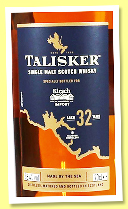
Talisker 32 yo 1993/2026 (58.4%, Ob, for Kirsch Import 50th Years, new charred American oak, 156 bottles)
Well, this baby does indeed seem to have been re-racked/finished in heavily charred American oak, as is currently the fashion at Diageo. But that doesn’t mean, absolutely not, that this bottling might be ‘inferior’ to versions matured more naturally (fill a cask and wait thirty years while praying to Vishnu or the Virgin Mary and all the saints). Let’s find out… Colour: full gold. Nose: there’s a little vanilla, crème brûlée and crema catalana, but in perfect balance with Talisker’s very maritime salinity, the whole thing leading to slightly smoky fudge enriched with pine sap. With water: fir liqueur mixed with seawater, with a drop of propolis extract. Mouth (neat): this is very good indeed, with preserved lemons, fir liqueur, cumin and juniper, coriander seed, as well as those famous sardines we mentioned above. The wood and its spices are noticeable, but perfectly integrated. And psst, we must move with the times. With water: everything relaxes, becoming fresher and, I was about to say, more ‘Talisker’. Finish: long, still quite marked by the re-racking, but that has also brought some lovely bitter notes, or so it seems to me. A feeling of salted limoncello and oysters in the aftertaste. Comments: a genuine miracle, I was afraid it might seem a little crushed, and certainly too ‘modern’, after those two old Cadenhead splendours, but that wasn’t the case at all. Enough to make us believe in Vishnu or the Virgin Mary (and all her saints). Or in progress.
SGP:465 - 92 points. |
| |
October 19, 2026 |
|
|

|
The Time Warp Sessions,
today Scapa some forty years apart |
We are delighted to see Pernod giving Scapa more of the attention it deserves, although there do not seem to be any ‘small batch’ or ‘single cask’ releases yet, unless we haven’t noticed them. In any case, the first official trio, 10, 16 and 21, is rather lovely, and we shall begin with a more recent bottling of that very 21-year-old. |
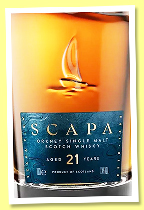
|
Scapa 21 yo (52.9%, OB, American oak, +/-2026)
WF 88 for the first version, released in 2024. You see, we are keeping tabs… Colour: light gold. Nose: pure juice from apples grown by the sea, Normandy or Brittany style. It is extremely simple and extremely lovely. Notes of fresh malt and orange cake emerge next, followed by earl grey tea and hints of orange butter, in the style of Martín Berasategui. Make of that what you will. Mouth: how good is this! Saline, coastal, admirably bitter, with a myriad of plants from both land and sea. Fresh bitter orange then takes charge. Finish: a lovely length, with an even saltier profile and little touches of mustard and pepper. Comments: this version seems tauter and less soft and fruity than last time. We could be mistaken, but either way, we love it.
SGP:561 - 89 points. |
Enough to sow a little doubt about all those excellent ‘Secret Orkney’ bottlings flooding the market. What if some were actually Scapa? |
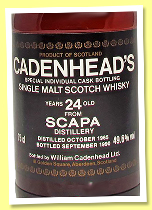
|
Scapa 24 yo 1965/1990 (49.6% Cadenhead)
This is a ‘special individual cask bottling’, you understand. Now we still imagine this could be the same spirit as the legendary Moon Import version, although nothing is certain. Anyway, onwards… Colour: light gold. Nose: let us say a more phenolic and maritime composition than modern Scapas, with cider, brake fluid, paraffin and Japanese wakame seaweed. Yet what is striking is that we are actually not all that far from the contemporary 21-year-old. Wafts of menthol cigarettes, Dunhill’s or Kool, according to your preference. Mouth: it shuffles its feet a little, with fairly pronounced OBE that seems to have dried the whole thing out a wee bit. Salted cardboard, green walnuts, Maggi, old pipe tobacco… Finish: fairly long but saltier and more bitter. A slight light-struck flavour. Comments: this bottle has probably seen better days, but it remains moving and, when all is said and done, excellent. 1965, just imagine!
SGP:352 - 85 points. |
(With thanks to the Absolutely Nuts) |
Check the index of all Scapa we've tasted |
| |
October 18, 2026 |
|
|
|
|
A word of caution
Let me please remind you that my humble assessments of any spirits are done from the point of view of a malt whisky enthusiast who, what's more, is aboslutely not an expert in rum, brandy, tequila, vodka, gin or any other spirits. Thank you – and peace! |
Seven rums of various styles
A little apéritif to begin with, hoping to prove that famous saying wrong: ‘We expected nothing and still end up disappointed'. |
|
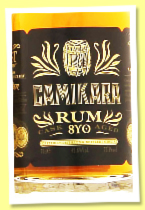
|
Camikara 8 yo (42.8%, India, +/-2026) 
An aged Indian rum produced by the Piccadilly Distillery in the state of Haryana, in northern India, made from pure cane juice rather than molasses, as is so often the case elsewhere in India. Colour: gold. Nose: very light, but far from unpleasant (maybe as a consequence), with caramel, unexpected hints of dried parsley, nougat and a little earthiness. Laterite, slag, potting compost, then mead… Mouth: admittedly, it does bring entry-level Martinique rum to mind a little, although it is much lighter indeed. Again, a very light caramel note and that earthy side. Certainly not an unpleasant rum indeed. Finish: a little longer than expected, leaning towards orange liqueur, still with that little touch of caramel. Comments: very, very decent, even rather good. Ish.
SGP:330 - 70 points. |
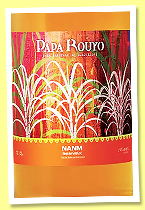
|
Papa Rouyo 2023/2026 ‘Nanm’ (58.43%, OB, Guadeloupe, agricole, cognac cask)
A single cask bottled at a remarkably precise strength. Those decimal places always look rather smart, don’t they? … Colour: full gold. Nose: lovely, starting with fresh oil paint, then olive oil and brine. All of this is spot on, and rather tauter than some other agricoles. With water: it softens, with a touch of good pastis and a camphory, almost medicinal side. Little aniseed biscuits. Mouth (neat): fine and precise indeed, with a slight orange vinegar note this time, then cane juice, black olives and salted liquorice. With water: don’t add too much! In any case, there is a lovely earthy salinity, a touch of bagasse, all very pretty. The cognac has kept a very low profile. Finish: quite long, still saline. Plantains, a savoury banana sauce, little mild olives… Comments: we really do like what the young Papa Rouyo distillery is doing, including this single cask. Now, I don’t think the extra 0.03% has anything to do with it.
SGP:562 - 88 points. |
Since we were on cognac casks… |
|
Neisson 11 yo 2014/2026 (51%, Artist #16 by LMDW, Les Anthologistes, Martinique, agricole, ex-cognac)
There is always something disappointing about Neisson, the complete absence of nasty surprises. The last time I tasted one that wasn’t quite to my liking was back when hens had teeth and pigs could fly (and not the other way round). Colour: full gold. Nose: mango, pink banana and, above all, vineyard peach. I couldn’t tell you whether that last aroma comes from the cognac or the rum. Or both. Then superb notes of sandalwood, incense, dried rose petals and liquorice. With water: eucalyptus and a little spearmint join in. Mouth (neat): both punchy and gentle, leaning more towards citrus fruit and oolong tea. The sandalwood is still there, joined by a little cedarwood. With water: the mint and eucalyptus return, along with a certain salinity. Finish: long, even more saline, drier, with much less fruit. Comments: superb, but yes, we did see that coming. Mind you, be sparing with your pipette here too, this is another agricole that isn’t much of a swimmer. In fact, at 51%, adding water is unnecessary.
SGP:561 - 90 points. |
|
Chamarel 8 yo 2017/2026 (63%, Habitation Velier, Mauritius)
Mauritian rums, some of them at any rate, seem to be moving upmarket. I’m not saying they don’t deserve to, if we leave aside the versions sweetened to ‘within an inch of their lives’. Let’s see… Colour: gold. Nose: gentle, although not really sugary on the nose. A light profile, banana and pear cake, aniseed and fennel, hints of paraffin… With water: toasted buckwheat tea, hojicha, mint and pastis… Mouth (neat): a similar profile, with more citrus fruit and even more pronounced fennel. Water will be the deciding factor on the palate… With water: the same profile, plus hints of fresh wood, cinnamon… Finish: medium in length, quite delicate, with unexpected notes of rock sugar and black tea. Comments: something of a velvet hand in an iron glove, if you see what I mean. In any case, it is towards the top of the Mauritian league and doesn’t struggle too much after the agricoles.
SGP:551 - 85 points. |
Since we’re in the Indian Ocean… |
|
Savanna ‘Eternal Summer 2026’ (59.2%, The Colours of Rum, Réunion)
It seems this blend/marriage contains quite a lot of Savanna HERR, so high-ester rum. The name ‘Eternal Summer’ is absolutely charming, provided it doesn’t apply to northern countries, wouldn’t you say? Colour: gold. Nose: bananas on the verge of fermenting, liquorice wood, petrol, varnish, capers and olives… All is well, then. With water: ‘Chinese’ notes, which I couldn’t describe any more precisely, except to say they remind me of a market, with dried fruits (jujubes, lychees) and dried fish. Among other things… Mouth (neat): very typical and distinctive, with that curious combination of varnish and liquorice, hints of acetone, fennel, lovage, then simply seawater. With water: we’re back at ‘the Chinese market’, and it is absolutely excellent. Dried shrimps, dried fruits and chen-pi. No, no durian. Finish: long, along the same lines, with salted liquorice returning to centre stage. Comments: simply excellent. Another distillery that remains at the top of its game.
SGP:652 - 88 points. |
|
Uitvlugt 26 yo 1999/2026 (49.2%, Frank McHardy Signature Reserve for Planet Spirits Singapore, Guyana, 140 bottles)
When Springbank’s sprightly and vastly experienced former distillery manager turns his attention to rum, it is bound to be intriguing… Colour: gold. Nose: one of those high-ester Uitvlugts that nevertheless remain balanced, with magnificent notes of fine green tea, dandelion flowers, little ripe apples, old paint tins in the cellar (from the days when solvents were still used with abandon), and cold mint tea. This is beautiful, branching off into fractals, especially the mints. Mouth: a little brutal, as we expected, but that doesn’t last. Shellfish and seaweed, smoked butter, earths, tobaccos, teas, cigars, and more and more seawater. Finish: long and even more saline, in the style of certain Bowmores. Don’t tell me they rolled the casks down the Demerara River all the way to Georgetown? A pleasingly bone-dry aftertaste. Comments: quite a ‘boom’ to all this. Complex and superb.
SGP:462 - 91 points. |
Right, I think we’ll finish with a new Hampden. Indeed, pretty much as usual… |
|
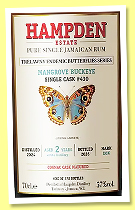
Hampden 2 yo 2024/2026 ‘DOK’ (57%, La Maison & Velier, Jamaica, Trelawny Endemic Butterflies Series, Mangrove Buckeye, cognac cask, cask #430, 378 bottles)
There is a whole series of these new, very young Hampdens, but we might as well choose the most extreme of the lot, a DOK! A reminder that DOK means something like 1.6 kilos of esters per hectolitre of pure alcohol, not far off the legal limit, or perhaps it is. Colour: white wine. Nose: petrol (not smuggled!), seawater, black olives, acetone and ammoniacal hints, then green pear. That said, it seems almost balanced to me so far. We get used to anything… With water: no change whatsoever. You can save water and, consequently, save the planet. Right. Mouth (neat): we’re some way from attempted murder here, it is almost gentle. All right, I’m exaggerating, it is wild, but we feel we have it under control, with that very salty liquorice, that petroleum, those almost rotten fruits, that ammonia… And those surprising hints of lavender. With water: back to basics. Olives, dried fish, acetone, varnish, petrol, fermented banana, seawater. Finish: more of the same. Very salty. Comments: not quite the last word in extremity, then. We tasted a new DOK 2021 last week that was more extreme than this, and by the way, we’re only just recovering.
SGP:463 - 90 points. |
In any case, I find it pretty incredible that Papa Rouyo has already earned its place among the world's finest rums. May the Force be with them! And after a DOK, nothing else stands a chance. |
Check the index of all rums we've tasted |
| |
October 16, 2026 |
|
|
A very lovely trio of Glenfarclas
The distillery has been presenting its new ‘190’ at several festivals this autumn, with the vivacious Debbie at the helm. So, success was more or less assured… |
|
 |
|
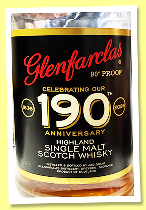
Glenfarclas ‘190 Anniversary’ (90° proof, OB, 15,000 bottles, 2026)
We rather like seeing the strength given as ‘90° proof’, whether it’s legal or not. To tell the truth, we’d rather it weren’t, we are French after all, but they probably know what they’re doing in Ballindalloch. Anyway, that’s 51.4% vol. Colour: golden amber. Nose: very cheerful, almost light, with walnut wine, slightly diluted amontillado, an old-fashioned orange cordial recipe and pipe tobacco in an old waxed tobacco pouch. With water: a walnut cake for twelve hungry people. Mouth (neat): very good, very much in keeping with the nose, with an added touch of calvados, or apples at any rate. With water: they’ve got this assemblage absolutely right, with a slightly earthy tobacco note that’s not unfamiliar in GF, followed by those walnuts again. In the end, the 90° proof works very well (ha). Finish: quite long, dry, with lovely bitter notes, malt, walnuts and bitter ale. Comments: I’m very taken with this celebratory concoction, I shall check its price forthwith.
SGP:361 - 88 points. |
|
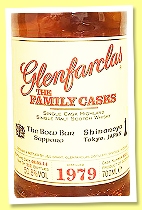
Glenfarclas 1979/2014 (50.8%, OB, Family Casks for Bow Bar & Shinanoya, Japan, hogshead, cask #8801, 212 bottles)
We should remember that Japan’s whisky bars have been on top of the world for a very long time. Colour: gold. Nose: the bright, precise side of Glenfarclas, indeed there have been official ‘square bottle’ releases in this style in the past. A beautiful combination of camphor, beeswax, apples, peppermint, eucalyptus and toasted sesame oil. With water: much the same, water is unnecessary. Mouth (neat): superb ‘secondary’ tension, dried flowers and dried fruits, all led by a perfectly balanced combination of green walnuts and lemon. The waxy side then comes through, much to our delight. With water: once again, water changes nothing apart from bringing out the lemon a little more. Lemon marmalade. Finish: much the same. Comments: this is quite beautiful and, forgive me, I find an ‘umami’ side to it that can only be a figment of my imagination.
SGP:451 - 90 points. |
Right, let’s go back even further in time for the last one… |
|
Glenfarclas 1965/2005 (48.5%, Scott’s Selection)
Here we have an old independently bottled Glenfarclas of approximately forty years of age. In short, a youngster… Colour: gold. Nose: waxes, hessian, mandarin peel, peach and apple skins, then a few touches of fennel and wormwood. Quite understated, very elegant, a little reserved, but this resistance to modernity can only be charming. Others would immediately have subjected it to some more or less brutal re-racking. Mouth: refined, admittedly a little bitter and herbaceous, but it all works, even if it tends to dive towards… the turf, almost like a rugby player. Finish: there are some lovely aspects, but overall it’s a little short on fruit. Comments: perhaps this lovely cask had already crossed the ‘maturity pass’ two or four years earlier. But it’s still very beautiful, of course.
SGP:361 - 85 points. |
| |
October 15, 2026 |
|
|
Some old Glen Grant
Because they are generally so graceful and elegant. And perhaps today we’ll manage to put together a lovely vertical tasting… |
 |
|
Glen Grant 29 yo 1994/2024 (52.1%, Hunter Laing, Old & Rare, refill barrel, cask #HL 57029, 173 bottles)
This was done to celebrate the launch of Ardnahoe. A very good reason indeed. Colour: English chardonnay. Joking. Nose: very fresh, with plenty of buttery brioche and apple tart. Not much to add at this stage, except for some curious notes of dried seaweed, kelp and nori... With water: hardly any change. Mouth (neat): very fresh, very much in the style of ‘modern Glen Grant’, with apples, cider and lager. The age barely shows. With water: pear juice now comes through as well, alongside some lovely green tea. Finish: not particularly long, but the green tea is now in full bloom. Comments: an old Glen Grant stripped bare, so to speak, which makes it rather lovely and even impressive, with the years having left remarkably little mark on it. We’d all love to be in such fine shape at an older age, wouldn’t we?
SGP: 451 - 86 points. |
|
Glen Grant 22 yo 2003/2026 (52%, Decadent Drams, 193 bottles)
Some story about vatting 19 yo and 31 yo GG, which I frankly cannot make head or tail of, but our soul is pure, friendly and willing. Anyway, life is too short. Colour: full gold. Nose: the pear is back, but there’s also shoe polish and cigars. Think a varnished cabinet full of Lusitanias, circa 1990s, they were great, which is about all we can remember. With water: old books, old papers, waxes, inks, even parchment… Mouth (neat): herbs and earth, followed by leaves and roots, all rather salty and ‘fino-ish’. It’s not exactly letting itself be tamed just yet. With water: bitter chocolate and roasted lupin herbal tea. Let’s just say it’s rather unusual… Finish: medium in length, dry, toasted, quite earthy. Comments: I reckon you should only add a single drop of water. Perhaps such instructions on the labels would be welcome?
SGP:451 - 87 points.
Important Update :
It’s not a mix of vintages, of course, it is indeed a 2003, I was talking nonsense. Blame the three wonderful festivals in Paris, London and Hamburg over three consecutive weekends, they must have drained a little too much of my mental energy. Ha! -S. |
|
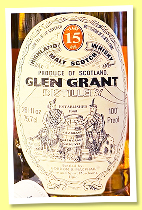
Glen Grant 15 yo (100° proof, OB, late 1970s)
Colour: gold. Nose: limestone, flint, very ripe apples, soluble aspirin, whatever the case, this ought to cure whatever ails you. With water: ham fat and fresh pollen, followed by clay and red-stemmed melon (chardonnay) from the Jura. Mouth (neat): superb tension between lemon and camphor. With water: teas and herbal infusions, all wonderfully elegant. Finish: more of the same, even if it doesn't last forever and ever (S.?) Comments: perhaps not the greatest of the old Glen Grants, but we're flying very high indeed.
SGP:461 - 89 points. |
|
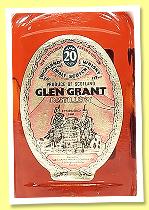
Glen Grant 20 yo ‘Director’s Reserve’ (46%, OB, decanter, +/-1970)
This bottle was coming with a decanter. As always, these rather improbable decanters can be a little unpredictable and may not have stood up terribly well to the ravages of time, but let’s not jump to conclusions and taste this baby without any preconceptions. After all we don't even know whether it was coming from the orignal bottle or if it had been transferred to the decanter. Colour: amber. Nose: oh, this is beautiful, with walnut wine from the finest walnut wine maker in the world, soot, coal smoke, elegantly grilled bacon, old books and bone marrow… Mouth: perfect, saline, almost peaty, certainly smoky, with an unexpected assertiveness (what?) Tobacco, coffee, salted butter caramel, truffles… Finish: long and more herbal. A slight fir-tree character and an unmistakable salinity, even if we cannot quite explain it. The aftertaste is less straightforward, very peppery, and it loses a few points at this stage. Comments: a grand old Glen Grant in the old style and, truth be told, we rather expected as much.
SGP:362 - 90 points. |
|
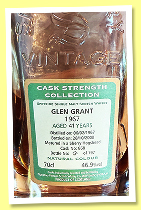
Glen Grant 41 yo 1967/2008 (46.9%, Signatory Vintage, Cask Strength Collection, sherry hogshead, cask #868, 197 bottles)
Let’s be clear, we’re approaching this baby with confidence and an almost unnecessary degree of determination. For let it be said, some of the most incredible Glen Grants we’ve ever tasted have come from the racing stables of Signatory Vintage. Colour: dark red amber. Nose: cedarwood, sandalwood, cigars, nutmeg, dried figs, dates and sultanas. In short, classic stuff. Mouth: tobacco, coffee, dried figs. We repeat, tobacco, coffee, dried figs. Finish: chocolate and coffee with kirsch. Comments: there’s a certain self-evident perfection here that requires no further explanation.
SGP:461 - 91 points. |
|
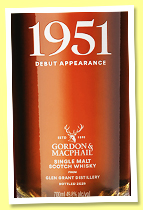
Glen Grant 1951/2026 ‘Debut Appearance’ (49.8%, Gordon & MacPhail, Sir Kenny Dalglish’s Vintage Moments, first fill puncheon)
We’ll say it again, G&M are the undisputed master of very old Glen Grants to die for. Colour: full amber. Nose: incredible chestnut cream with chestnut honey and custard. An absolute, sublime stunner, after seventy-five years of ageing, if our maths is right. Nothing to add, except perhaps a spontaneous mention of little touches of myrtle liqueur. Mouth: it’s a little dry-dry now, but this ultimate combination of salty and ultra-dry notes works remarkably well, with an almost Nietzschean edge. Finish: very dry, very long, bitter, almost drying, yet outrageously elegant. Comments: the fruit has all but vanished, but there’s plenty of very bitter chocolate. Mind you, I have no idea whether Sir Kenny is fond of bitter chocolate.
SGP:261 - 90 points. |
| |
October 14, 2026 |
|
|
A little Glenrothes
There’s no shortage of Glenrothes amongst the independent bottlers, but for now we’ll content ourselves with two or three expressions. Plenty more to come later… But first, an official apéritif…
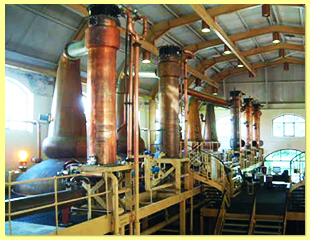
Glenrothes stillhouse in 2003 (WF Archive) |
 |
|
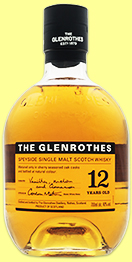
Glenrothes 12 yo (40%, OB, sherry seasoned oak casks, +/-2025)
We find the expression ‘sherry seasoned’ rather underwhelming, the 40% ABV even more so. But our souls are pure and we remain hopeful. Besides, the last 12-year-old we tried was very good (WF 85). Colour: gold. Nose: that’s the thing, the malt is lovely, so are the slightly singed cakes, the oranges are lovelier still, and the macaroons take the biscuit (ooh!). Mouth: no, this is very good, waxy and full of orange cake, with little to complain about, even if a little more wattage would have been welcome. Touches of oatcakes dipped in chocolate. Finish: admittedly short, but balanced and nicely fruity, with the oranges firmly in charge. Comments: a very pretty little malt that should please everyone. Would there happen to be a CS or 100 proof version?
SGP: 541 - 85 points. |
Let’s move on to some well-aged independent bottlings, shall we say two of them… |
|
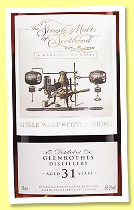
Glenrothes 31 yo (53.2%, The Single Malts of Scotland, hogshead x sherry butt, 560 bottles, 2022)
A marriage of 1989 and 1990. We’re a little late to the party, agreed, but this is Whiskyfun. Colour: full amber. Nose: honey and caramel, a twelve-kilometre-long tarte tatin (you get the idea) and maple syrup. With water: more fermentary notes, malt, beer, leather, tobacco… Mouth (neat): much livelier than expected at such a venerable age, with plenty of spices leading the charge. Cinnamon, nutmeg… With water: fresher and fruitier once we’ve added water, but the spices refuse to budge and defend their position with gusto. Finish: long, a little grassy and dry. Quite a bit of pepper in the aftertaste. Comments: a very fine old Glenrothes, although the spices rather rule the roost on the palate. We found the nose more easy-going.
SGP: 561 - 87 points. |
|
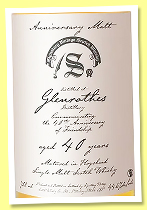
Glenrothes 40 yo 1986/2026 (44.6%, Signatory Vintage, Anniversary Malt, LMDW Anthologistes)
This baby’s commemorating the 40th Anniversary of Friendship between La Maison du Whisky and Signatory Vintage. All very lovely, these occasions often yield some rather splendid bottlings. We also like the fairly light colour for a malt of this age, often a very good sign… Colour: bright gold. Nose: barley, apple, orange, beeswax, pollen, a little paraffin, then marmalade and orgeat. Very precise and well-defined for a malt of this age. Mouth: excellent, fresh, sprightly, very lightly mentholated at first, then we have orchard fruits, pears, plums, apples, peaches… And all the cakes and pastries we might make with them. Apple turnovers in particular, true works of art when done properly. Finish: medium in length, moving towards herbal teas, but the wax and apples keep a watchful eye, while orange notes enliven the aftertaste. Comments: much less fragile than we might have expected, which is already quite an achievement in itself. Very, very good, we think.
SGP:
551 - 89 points. |
We’ll be back soon with plenty more Glenrothes… |
| |
October 13, 2026 |
|
|
Indiana Jones and the Secret Giraffe
(Or two wee Glenmorangies and some red wine)
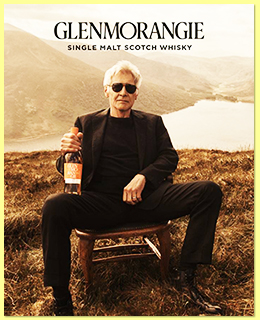
No shame, really. I mean, us. So, there’s this fairly recent Glenmorangie NAS endorsed by Harrison Ford, whose rather engaging face was plastered all over London and the airports, and a mysterious new blended malt from Murray McDavid going by the charming name of ‘Girafe Chic’. The giraffe is, of course, a nod to the famously tall, slender stills at the celebrated Tain distillery. |
 |
|
Glenmorangie ‘Harrison Ford’ (46.5%, OB, bourbon and Portuguese red wine, +/-2026) 
We should remember that Glenmorangie and their ever-dashing master blender were among the pioneers of finishing in still wine (unfortified) casks, with Margaux versions appearing as early as 2006 (more on that below). Colour: pale gold. Nose: nothing remotely winey in the wrong sense, quite the opposite, although the casks had been toasted. Buttercream, mashed potatoes with lashings of butter (Robuchon-style, 50% potato, 50% butter), then green fruits, gooseberries, and finally, indeed, red berries, leaning towards blackcurrants, including their buds. Perhaps a little mild curry paste too, probably courtesy of the oak. Mouth: definitely more on red wine, but without overdoing it, with even little hints of grape pips and stalks, followed by touches of green walnut and cinnamon. It’s pleasant, although rather less soft, creamy and cakey than some of the other young Glenmorangies we enjoy. Finish: medium in length, with no major changes until the aftertaste, where yellow fruits appear, especially some welcome apricots. Comments: a lovely bottling, quite different from the rest of the range. We like it, and rest assured, we shall even carefully refrain from making any cheap film jokes. The headline above was already uncalled for, we agree. Well, we might add that Mr Ford is rather ‘no age statement’ himself.
SGP:541 - 83 points. |
|
La Girafe Chic 28 yo 1997/2026 (52.9%, Murray McDavid, Mission Gold, Margaux + PX sherry, 573 bottles)
Isn’t it amusing that they chose Margaux rather than a wine from the Rhône valley, more precisely from the area around Tain. Tain l’Hermitage, of course… The distillery itself actually released a 1975 ‘Tain L’Hermitage’ (from Chapoutier) in 2003. And Margaux versions too, of course. Anyway, MMcD previously bottled a rather gingery 25-year-old ‘Girafe Chic’, but I don’t think that one had seen any PX. Let’s see whether the latter has rounded things off… Colour: full gold. Nose: we’re not huge fans of sweet PX (seco, on the other hand, absolutely), but it seems to work very well here, with some lovely raisins and a surprisingly fresh spicy side. Bay leaves, seaweed, menthol tobacco, barely chewed liquorice root… With water: tobacco, a little gunpowder, dark chocolate, mocha, and slightly burnt raisins. Our favourites. Then a little blackberry jam, which we love with caramel. Mouth (neat): I really like this avalanche of walnut liqueur, currants and sultanas, liquorice, pepper and sweet paprika, followed by touches of candied cherry. That must be the Margaux… With water: not much further development, but never mind, it’s all rather splendid. Finish: medium in length, with spices, peppers and buds. A more peppery aftertaste. Comments: I think the PX deserves a round of applause here. I like this 28 much better than the 25 from two or three years ago.
SGP:551 - 87 points. |
| |
October 12, 2026 |
|
|
A wee trio of Glengoyne
We do like Glengoyne, the Highlander of the Lowlands, unless it’s the other way round… But first, an apéritif… |
|
Glengoyne 10 yo (40%, OB, +/-2005)
Perhaps not an outright star at the time, but it’s always nice to try, or revisit, these emblematic malts from… ahem, twenty years ago. Colour: gold. Nose: I reckon it has benefited from its twenty years in bottle, having become pleasantly rounded, with orange cake, acacia honey, peaches and cherries… But beware, these lovely noses don’t necessarily promise equally lovely palates with entry-level malts. Let’s see… Mouth: yes indeed, it’s nicely malty and caramelly, with nougat and café latte. Finish: more of the same, with the orange cake returning, drizzled with caramel. Comments: very decent, classic, well made. I really do think the ‘ageing’ in bottle has done it some good, even if the caramel remains a little overdone for my taste.
SGP:541 - 80 points. |
Let’s move on to the very latest baby… |
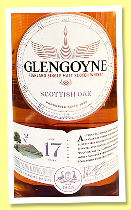
|
Glengoyne 17 yo ‘Scottish Oak’ (51.6%, OB, 2026)
This was finished in ‘sustainably sourced’ (compulsory wording these days, isn’t it) Scottish oak. Glengoyne had already done this in the past, for instance with a 15-year-old back in 2007, and we liked it very much (WF 87), however odd that may sound. And so… Colour: full gold. Nose: listen, I’m sorry, but the Scottish oak seems to lend the whisky a rather… Japanese character. Green spices, fir, bean curd, even green oranges, or at least their interpretation by the perfumers at Hermès. Very nice. With water: the pine resin becomes even more pronounced. Lovely, we like this. Mouth (neat): much the same impression, green oranges, lemongrass, bergamot, liquorice, it’s really rather lovely. With water: still just as good, fresh, lemony and sappy. Finish: more of the same. Easy on the water, as with all whiskies where the oak makes its presence felt. Comments: I’ll dare to say it, this rather reminds me of those ‘mizunara-inside’ whiskies. Will they ever forgive me for saying that?
SGP:461 - 87 points. |
Right, let’s try an indie, there aren’t that many about these days… Independent Glengoynes, I mean. |
|
Glengoyne 11 yo 2014/2026 (55%, Signatory Vintage, Cask Strength Collection, 1st fill bourbon barrel, cask #700443, 234 bottles)
Colour: white wine. Nose: lemon and orange drops, jellybeans, liquorice allsorts, marshmallows. Must I repeat myself? With water: it does not budge an inch. Perhaps a few rather ripe gooseberries. Mouth (neat): we’re back to lemon drops, multiplied by ten, then apple juice and kiwi jam. This is so utterly ‘unpeated’ that even Auchentoshan seems smoky by comparison. With water: a fruitiness we might call positively cheeky, or a family-sized bag of British fruit sweets straight from Heathrow or Gatwick duty-free (price × 1.5). Finish: more of the same, only even fruitier. Comments: I reckon this outrageously fruity baby could win over even the most implacable opponent of malt whisky. Should any such person exist, of course…
SGP:740 - 85 points. |
| |
October 11, 2026 |
|
|

|
The Rum Sessions,
the new rums start to pour in |
It’s peak season for new releases, and we’ll try to stem the rising tide. That said, the succession of festivals of interstellar calibre is making it a little tricky to put together the grand malternative line-ups we so enjoy, but things should be back to normal next week, provided we survive the German currywursts this weekend (it’s Hamburg, baby). I should add that we adore currywurst and only wish we found its aromas and flavours in our spirits a little more often… Right, an apéritif…
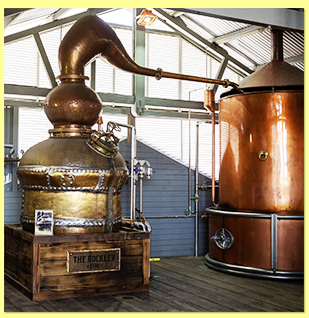
The 18th century Rockley still (Stade's Rum/W.I.R.D.) |
 |
|
Bahari ‘South Africa Edition’ (43%, OB, South Africa, +/-2026)
A very young blend of aged and unaged pot still rums, sourced entirely from South Africa (Sugar Baron and L’Atelier). I humbly confess to knowing neither distillery… For now! Colour: white wine. Nose: it’s young, a little sweet on the nose, a little grassy, a little pear-led, but lovely sugar cane notes then emerge, and the whole is pleasantly fresh. Mouth: really not bad, though it doesn’t quite scale the heights of Mhoba. Perhaps a little light, but rather nicely saline. Green apple. Finish: very short, which is a bit of a shame. Comments: we’ll call this baby honest, fair and fit for trade. We appreciate the absence of added sugars, syrups and assorted liqueurs, at least any we can detect.
SGP:440 - 78 points. |
|
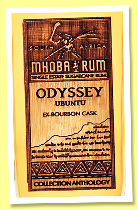
Mhoba ‘Odyssey’ (58.5%, OB, South Africa, LMDW Collection Anthologie, bourbon barrel, cask #BC-1, 188 bottles, 2026)
Mhoba just keeps getting better, it’s almost becoming worrying. We’re joking, but this baby is 86 months old. If my arithmetic is sound, that makes it a little over 7 years. Colour: gold. Nose: immediately fragrant with Jamaican-style esters (I know, esters are esters), rubber, dried seaweed, acetone, new plastics, overripe banana and seawater. With water: and dried mushrooms, especially morels and ceps! Mouth (neat): excellent, of course, perhaps slightly less extreme and a little more citrusy than other expressions, though I could be wrong. Lemon, olives, varnish, agave… With water: very little change, and we’re not complaining, perhaps the olives move a little further forward. Finish: long, a little sweet, but still full of character. Comments: we’re thinking of a decidedly global triangle linking Jamaica, Fiji and South Africa. Last year’s ‘Satara’ was perhaps slightly more assertive, though.
SGP:552 - 89 points. |
|
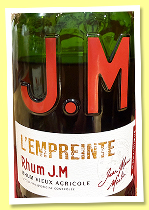
Rhum J.M ‘L’Empreinte’ (41.5%, OB, Martinique, agricole, 2026)
A very young, limited edition of J.M at a modest strength, let’s see whether there are still a few watts or horsepower under the bonnet… Colour: gold. Nose: very typical but spicier than usual, with cinnamon biscuits and toasted buckwheat, then Seville orange marmalade and wafts of jasmine. You almost feel you’re in a (very good) Chinese restaurant. Mouth: consistent with the nose, though a little weaker, which is only to be expected at this strength. Lovely oranges, a little juniper, cane juice, cedarwood, a touch of mild curry. Finish: a shame, it takes a bit of a nosedive here, which is rather frustrating, let’s admit it. But the spices in the aftertaste remain very, very lovely. Comments: come on, a slightly more ‘unbridled’ version, please, the profile is quite magnificent.
SGP:541 - 82 points. |
|
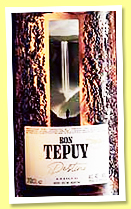
Ron Tepuy ‘Destino’ (40%, OB, Venezuela, +/-2026) 
A brand I hadn’t come across before. Obviously, at 40% vol., our hopes aren’t terribly high, although it’s better than 38% (what a useful comment that was, S.!) Colour: deep amber. Nose: oranges, agave syrup, caramel, triple-sec… Not bad. Mouth: a little flabby, not too sweet, becoming drier, with black tea sweetened with honey and a touch of bagasse. Very light structure. Finish: ultra-short. Comments: not too bad, actually, at least it hasn’t been ‘dosed’ to death, but perhaps best kept for cocktails? I mean, light cocktails?
SGP:320 - 69 points. |
|
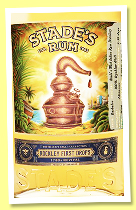
Stade’s Rum ‘Rockley First Drops’ (49%, OB, Barbados, bourbon cask, 1,200 bottles, 2026)
A rum from W.I.R.D., distilled in the Rockley Still, said to be the oldest rum still in the world. 200+g esters/HLPA. Colour: chardonnay. Nose: it’s all there, but gently so, with seawater, a little vinegar, a touch of acetone and ammonia, brine, liquorice root, a little lime juice and hints of gentian. Tropical gentian, of course. Mouth: much the same, in a style we really must call Jamaican. Trelawny, a little less oily and with a little more pepper from the distillate. Finish: fairly long, still with lovely peppery notes alongside the classic combination of liquorice, salt, olives and varnish. Comments: I find this very good indeed, with something of a ‘Bowmore of the Caribbean’ character (eh???) We’re hoping for a 100-proof version.
SGP:462 - 88 points. |
|
Hampden 10 yo 'Great House Distillery Edition 2026' (55%, OB, Jamaica)
Colour: full gold. Nose: of course. With water: of course. Mouth (neat): of course. With water: of course. Finish: of course. Comments: more seriously, the nose combines pencil shavings, charcoal and shellfish, while the palate is much more saline, with olives, brined lemons, capers, seaweed, rubber, seawater and salmiak. Let’s not forget the customary drop of fresh paint and that slight hint of peat that so often has us calling Hampden the Ardbeg of the Caribbean. Note that neither Hampden nor Ardbeg have ever complained.
SGP:463 - 90 points. |
There’ll be plenty more rums (and Hampdens) on WF over the coming weeks, stay tuned. |
Check the index of all rums we've tasted |
| |
October 9, 2026 |
|
|
|
The Time Warp Sessions,
today Pulteney 17 vs 50 |
The north-east coast gang! You may have noticed that we shamelessly seize every opportunity to taste Pulteney, and today’s duo is quite something, as we’re pitting a new 17-year-old for LMDW at a rather explosive strength against the celebrated official 50-year-old released this year. Somewhat unusually, we’ll start with the latter, on account of its much ‘gentler’ bottling strength. |
|
Old Pulteney 50 yo (40.8%, OB, 200 bottles, 2026)
The oldest Pulteney ever bottled, we could almost call it ‘Old Old Pulteney’, were that not rather inelegant. Speaking of elegance, I find the bottle beautifully refined, perhaps unlike much of what other distillers tend to produce for whiskies boasting this sort of pedigree. Anyway, this is a marriage of four casks aged at least fifty years, brought together to celebrate the distillery’s bicentenary this year (1826-2026). Colour: gold. Nose: what freshness! Beautiful notes of oolong tea, wonderfully precise kiwi and equally precise apple, honeysuckle, sweet woodruff, just the right amounts of liquorice and mint, a surprising touch of pear (at fifty!) and then a few distinctly maritime wafts, quite real rather than imagined, in the shape of samphire. It’s beautiful, fresh, almost cheerful and sprightly. Mouth: a mirror of the nose, with a little more oolong tea and a little less fresh fruit, but the components are otherwise identical, save for a little oak that inevitably now puts in an appearance. At 50 years and 41% vol., it would have been very surprising otherwise. Finish: short but fresh, with touches of gooseberry, wakame and little orchard apples. More fairly well-steeped green tea in the aftertaste, but again, that’s only to be expected. Comments: there’s a faint sense of a miracle here and there, and a slight fragility on the palate that ultimately only adds to the considerable charm of this beautiful 50-year-old. It proves, re-racking or no re-racking, that no, not all malts fall apart after 35 years in cask.
SGP:441 - 90 points. |
|
Old Pulteney 17 yo 2009/2026 (64.8%, OB for LMDW, Collection Anthologie, first fill bourbon barrel, cask #268, 186 bottles)
At this strength, either the cask matured right at the top of a palletised warehouse, or we’re already seeing the effects of climate change. Or both… But that tells us nothing about the quality of this inevitably rather potent baby. Colour: gold. Nose: I don’t think I’ve found quite so much citrus in a malt whisky, certainly not recently. Incredible blood oranges, followed by a procession of bergamot, mandarins and citrons. Needless to say, we adore this. But careful, we’re at almost 65% vol… so, with water: believe it or not, it barely changes, even at +/-45%, except that it becomes a little more vanilla-led, with hints of mango syrup too. Mouth (neat): another explosion of citrus and orange blossom, with an inevitable earl grey tea character. And quite a bit of ethanol… With water: it takes off towards passion fruit, little shellfish, green pepper and plain old lemon. Touches of wax bring to mind the nearest distillery to the south. Finish: inevitably a little ‘limoncello-y’, with a duo of peppermint and little oysters in the background, then that wakame we mentioned above. Comments: you know what, let’s not overthink this, we’ll give it the same score. So, should you acquire this magnificent Pulteney rather than its ancestor, you’ll have saved yourself a very tidy sum in the process. We’re joking, such considerations are rather vulgar, of course…
SGP:651 - 90 points. |
| |
October 8, 2026 |
|
|
An infernal trio of Highland Parks
In other words, a vertical tasting, 1968, 1974, 1996. Or rather the other way round… Let’s start, by way of an aperitif, with a little mystery blend… |
|
Old Orkney Relics 30 yo 1996/2026 (41.7%, Decadent Drinks, blended Scotch, refill sherry butt, 492 bottles)
A bottling sourced from the stocks of Gordon & MacPhail, the previous owner of the brand, which pays tribute to the origins of the OO Relics name, hence Stromness. Single vintage/single cask blends are always a little mysterious, since that combination is normally the preserve of… single malts or single grains. So how did several whiskies end up together in one cask while all being from the same vintage? Had they been blended at birth? Or perhaps blended later and then re-racked into this butt? I may be missing something… Colour: gold. Nose: a surprising combination of young calvados, old fino sherry, smoked butter, pale ale, old hessian sacks that have been lying around in an ancient cellar, furniture polish and kombucha. It’s fresh and even rather joyful, and to tell you the truth I’m not detecting hectolitres of grain whisky. Mouth: I was a little afraid it might be too fragile, but not really, the fino side only grows stronger, as do the earthy and slightly smoky notes, before it heads towards some old mead made for the locals rather than the tourists. Notes of grapefruit liqueur and the return of the calvados (50% apple, 50% pear). Finish: this is, I was about to say inevitably, its slightly weaker part, as is often the case with these kinds of whiskies, but it still holds up very well, with lovely green walnuts and roasted tea. Comments: ‘almost’ 90, only the finish held it back a little. Indeed, that was to be expected…
SGP:352 - 89 points. |
|
Highland Park 13 yo 1974/1987 (58.4%, Intertrade)
We had already tasted, earlier this year and in similar circumstances, the 16 yo 1970 Intertrade, which Nadi Fiori, the epitome of moustachioed Italian elegance, had graciously given the world… a very long time ago. Colour: white wine. Nose: you see, these are those Highland Parks that are all about chalk, light oils (the gearbox oil of a Miura, ha), mandarin and the proverbial heather honey. Formidable. With water: it remains pinpoint precise, yet oily at the same time. Above all, it’s very ‘HP’. Mouth (neat): a simply dazzling assortment of citrus fruits and some equally dazzling little saline bitters. Oily and almost thick in texture (we shan’t start talking about Italian engines again, rest assured). With water: in comes the smoke, together with shellfish, preserved lemons, tobacco and a few hints of not-quite-ripe mango. Finish: the finish is more mineral, so in a way it ends just as it began on the nose. Barley and mandarin sing in the aftertaste. Did we mention the heather? Comments: an improbable ratio of youth in cask to age in bottle. I think I like it even more than the 16 yo.
SGP:562 - 93 points. |
|
Highland Park 54 yo 1968/2023 (46.9%, OB, refill and 1st fill sherry, 225 bottles)
Oh blast, I’ve just realised that we had already tasted this baby when it came out, in 2023. Having quickly reread my notes from back then, I’d say I haven’t changed my mind in the slightest, and in doing so hereby declare this to be the shortest tasting note in the world.
SGP:651 - 93 points (unchanged, naturally). |
What to do? I have an idea, let’s change tack completely and try a straightforward, very young little whisky that really impressed me at the Whisky Show in London. That way, we’ll have had a proper ‘trio’ today after all. |
|
Miraon (50.3%, OB, South Korea, rice shochu, cask #2604, 2026)
Some two-and-a-half-year-old whisky shochu made at Hwasimjujo Distillery. A first for me. Rice is indeed a grain, and here it is heavily roasted before being milled, brewed and distilled. Colour: gold. Nose: full-on smoky and slightly salty crème caramel, the floral side of rice spirit (ylang-ylang, perhaps), fresh mushrooms and a terrific combination of pine sap and fresh natural rubber. I promise you, it’s much less unlikely than it sounds. With water: earth, moss, leaves, green tea, fresh barley (I know, it’s rice) … Mouth (neat): brilliant arrival, very direct and ultra-lemony, before unleashing all manner of little earthy spices. Saffron seems pretty obvious too, as does roasted tea (Japanese hojicha). With water: even better. Aniseed, pine sap, cardamom, dried mushrooms, and of course lemons. Finish: same. Comments: very impressive for its age. We’ll see whether, once it reaches three years of age, they still choose to call it ‘shochu’, as they do now, or switch to ‘whisky’. I’d bet on the former, or perhaps K-Whisky. Ha.
SGP:562 - 87 points. |
| |
October 7, 2026 |
|
|

|
|
WF's Little Duos, today:
old old Longmorn G&M versus new old Longmorn G&M |
Let’s say it without fear: when it comes to Longmorn (or Strathisla, Glen Grant and perhaps a few other), especially the older vintages, Gordon & MacPhail have always been masters of the game. And we’re about to prove it once again… All strictly personal opinion, of course, as always. Even the proof.
Sir Kenny Dalglish’s Vintage Moments (Gordon & MacPhail) |
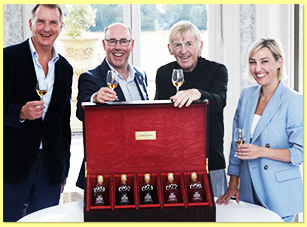 |
|
Longmorn 25 yo (43%, Gordon & MacPhail Reserve, sherry, cask #3233, 2001)
A bottling for Dieter Kirsch in Germany (Kirsch Import), curiously lacking a vintage, but with an extremely reassuring pedigree, nonetheless. Colour: deep amber. Nose: great elegance and restraint, opening on vanilla-scented chestnut cream with the lightest dash of rum, followed by fairly mellow sherry, honey, two drops of soy sauce and orange marmalade. At no point do the 43% feel thin, so far at least. In any case, we know Longmorn carries these gentler bottling strengths very well. Mouth: a rather surprising mix of praline and salted butter caramel, even lightly salted peanut butter, followed by milk chocolate and a few sultanas. All very elegant. Ripe orchard fruits then develop, along with the customary black pepper. Finish: not terribly long, a little drier and earthier too. We shall have the temerity to dock a point for that reason alone. Boo. Comments: perhaps a little less fruity than other Longmorns of this ilk, but excellent all the same, as we rather expected.
SGP:451 - 90 points. |
|
Longmorn 1967/2026 ‘Into the Lion’s Den’ (45.5%, Gordon & MacPhail, Sir Kenny Dalglish’s Vintage Moments, cask #3340)
Part of a rather extraordinary little new series marking, in its own way, the highlights of Kenny Dalglish’s career. Probably Scotland’s most famous footballer (I hope I’m not ruffling any feathers by saying that, I’m no expert). Colour: glowing amber. Nose: for a malt pushing sixty, this is extraordinarily fresh, opening on almond and hazelnut creams with light touches of camphor, followed by magnificent prunes in Armagnac. Or kirsch, come to think of it. Then come tiny, very discreet fruitcakes and delicate hints of fennel seeds. Finally, traces of some very upmarket moisturiser. Mouth: these Longmorns really are killers. This time we begin where the nose left off, with touches of cosmetics, before an avalanche of coffee chocolate (or chocolate coffee, take your pick) comes tumbling onto the palate. The customary walnut wine rounds things off with panache. Finish: long and, this time, fruitier, whereas the opposite so often happens. Plums, cherries in eau-de-vie, coffee-schnapps. A very light woody touch in the aftertaste. Comments: I don’t know whether Sir Kenny ever beat France’s national team, but if he did, which would hardly have been surprising, he should know that all is now forgiven!
SGP:561 - 92 points. |
We’re happily closing in on 300 Longmorns on WF. Perhaps before the year is out? |
| |
October 6, 2026 |
|
|
A wee trio of Ardbeg
Because it was high time we tasted the new official 15-year-old, to which we’ll add two independents, one very recent, the other rather very old. Does that sound like a nice little line-up?
(Early 1990s range including the former 15 yo - WF Archive) |
|
 |

|
Ardbeg 15 yo ‘Trudernish’ (48.8%, OB, 2026)
Here is ‘A Smoky Dram of Creamy Harmony’ matured in bourbon, new charred oak and oloroso sherry casks. Trudernish is a small hamlet in the south of Islay, and a ‘story’ that’s rather less far-fetched than some others, it has to be said. We quite like all this… Colour: white wine. Nose: this is typical Ardbeg, fresh, precise, and very much in the vein of the Ten that we like so much at WF. Slightly resinous and tarry peat, but never excessively so, with light touches of capers and olives, a few oysters that happened to be passing by, and, indeed, a sense of harmony, or even fullness, without being too ‘creamy’. Good news, if you ask me. Mouth: this time there are a few touches of bergamot and even pineapple, typical of deep-charred wood, but once again the balance has been preserved and all the maritime character remains. Including the oysters, seaweed and lemons. Finish: medium in length but crystal-clear in profile, and above all refreshing. A lovely duo of salted mint and salted aniseed in the aftertaste. Comments: the oloroso is anecdotal. Somewhere along the way, we’re reminded of the old ten and the very rare old fifteen from more than thirty years ago. Careful, this goes down all too easily, so it’s a little dangerous.
SGP:566 - 88 points. |

|
Ardbeg 17 yo 2008/2026 (57.2%, Murray McDavid, Mission Gold, oloroso sherry butt, 149 bottles)
MMcD have had some cracking Ardbegs in the past, so we’re all ears. So to speak… Colour: gold. Nose: the oloroso isn’t dominating, that’s the first bit of good news. There are certainly walnuts and tobacco, even little touches of black truffle, but in the end, and upon reflection, it moves increasingly towards smoked and grilled bacon, as well as artichoke and aubergine. It’s rather intriguing and feels a little like a seaside barbecue, but it’s truly charming. With water: a few cheesy touches (Stilton) and some kelp. Mouth (neat): massive. Orange zest, black pepper, juniper, brine, winkles and walnut wine. More or less… With water: everything falls back into line a little, and we almost regret that. Oysters, light Ardbeggian tar, lemons, gentian… Finish: long, on a duet of smoked lemon and seawater. Lime in the aftertaste, now that’s perfect. Comments: in the old days, what we looked for from the independents were variations, versions that strayed quite markedly from the official bottlings. We’re certainly getting that here, much to our delight. It could hardly be more different from the ‘Trudernish’, and yet for us the level is similar. A very fine bottle indeed.
SGP:567 - 88 points. |
We did say an old one, didn’t we? |

|
Ardbeg 1974/1988 (55.1%, Scotch Malt Whisky Society, #33.8)
These babies are getting increasingly rare, and these tasting notes, consequently, increasingly useless. But that doesn’t bother us, should it? Of course, 1974 means ‘Provenance’, and ‘Provenance’ means one of the true Hyperardbegs. I know what I mean… Colour: pale gold. Nose: star early 1970s ‘beg, little cask influence, fully distillate-driven, 100% crystal-clear line, peat and tar, then wax and lemons, plus two or three shellfish. Let’s say cockles, clams and razor clams (what utter nonsense, S.!) With water: but who on earth first had the mad idea of taking lemons, smoking them, then putting them in brine? Mouth (neat): this is so good, fresh, precise, taut, citrusy, tarry, saline, with this incredible smoky & salty daiquiri side. It’s the combination of thickness and freshness that is the most impressive of all. With water: I give up, this is just too good. Finish: I said I give up, OK? Comments: half a day in the fridge (I know, I know) then with some absolutely top-notch caviar. With blinis, naturally. And friends.
SGP:467 - 94 points. |
| |
October 4, 2026 |
|
|
|
|
A word of caution
Let me please remind you that my humble assessments of any spirits are done from the point of view of a malt whisky enthusiast who, what's more, is aboslutely not an expert in rum, brandy, tequila, vodka, gin or any other spirits. Thank you – and peace! |
One Cognac, and what a Cognac
We hadn’t planned on publishing anything today, being rather pleasantly knocked sideways by the very enjoyably lethal run of Whisky Live Paris, the Whisky Show in London this weekend (we’re there as we speak), and then Whisky Live Germany in Hamburg next week. But there you have it, in London we stumbled upon a rather incredible little gem and simply couldn’t resist publishing its ‘official’ tasting note (right) without further ado. So here it is… |
 |
|
Île d’Oléron 18 yo 2007/2026 (50.3%, Jean Grosperrin, Bois Ordinaires)
This one comes from a tiny estate in Saint-Pierre-d’Oléron, whose owner retired after the 2007 harvest, so this should actually be the property’s very last vintage. Oléron cognacs are proper island spirits, grown on sandy soils right by the Atlantic, and mature examples have become exceedingly rare. We’ve already tried an excellent 18-year-old from the same estate back in 2022 (WF 88), so expectations are not exactly low. Besides, any spirit that comes from an island already has an unfair advantage on Whiskyfun. Ha! Colour: pure gold. Nose: fat, almost oily, with a texture reminiscent of a great malt and, astonishingly, something rather Bruichladdichian about it. Lots of melon skin, a few maritime touches (without quite venturing into seaweed and oysters, mind you), and some magnificent sandalwood. There’s also a little tinned peach, as in many lovely cognacs, and even a few fresh mint leaves that seem to have been dragged through the soil. In short, I adore this nose. Mouth: a little closer to classic cognac this time, but there’s some pretty massive cinnamon (cinnamon biscuits), damson tart (sprinkled with cinnamon, right), and a few small raisins wandering through. It all ends up rather like speculoos. Finish: long and surprisingly fresh. The little mint returns in the aftertaste, together with a salty, resinous touch that turns one last somersault right at the end. Comments: as we used to say in the early days of whisky ‘blogging’, I’d like to marry this cognac. As for the price, I believe it is clearly ‘typo-ish’. See what I mean.
SGP:551 - 90 points. |
| |
October 2, 2026 |
|
|
|
The Time Warp Sessions,
today indie Clynelish,
33 years apart |
No month without Clynelish, and this time we’re getting in early. There. |
|
Clynelish 10 yo 2016/2026 (57.8%, Signatory Vintage, Cask Strength Collection, new wood hogshead, cask #307816, 279 bottles)
The story doesn’t say whether this is US or EU oak, or even mizunara, although we may safely leave that last possibility to the dreamers. Most likely American… Colour: pale gold. Nose: this is curious, the oak immediately brings rooty, mentholated and resinous touches, but some fairly rich beer, followed by remarkably precise and studious beeswax (studious bees?) and then lemon take over. It’s rather fresh and taut so far, no lumberyard disaster in sight. With water: the bergamot literally explodes, get your Italicus Spritz ready! Mouth (neat): very powerful, very lemony, almost violent, but with the Clynelish markers clearly present in the background, thank goodness. Wax and mandarins. It’ll be fun to compare this with the 1983 that follows, which could display a similar profile, although thirty-three years ought to count for something. With water: really excellent, with more roots again, ginseng, fresh turmeric, lemon zest, light brine, white pepper. Finish: long and fresh, citrusy, saline, with a little nod to the distillery further north, in Wick. No names, naturally. Comments: in the old days it was considered that using new oak made no sense whatsoever for Scotch malt. Perhaps those were strictly economic considerations at the time… (accountants, we salute you).
SGP:461 - 88 points. |
|
Clynelish 19 yo 1983/2002 (56.6%, Scotch Malt Whisky Society, #26.23)
We adore 1983 Clynelish, not least some absolutely legendary Samarolis. We’ve also tasted several other 1983 SMWSs, some of them fabulous, but never this one. Let’s go… Colour: pale gold. Nose: the beeswax and mandarin are much more emphatic here, wonderfully concentrated and sharply defined. In fact, there’s hardly anything else, but the precision is quite sublime. Why ask for more? With water: camphor, fresh bandages, a touch of effervescent aspirin, perhaps even Berocca, then pollen and that proverbial beeswax that suddenly makes you want to go and light a candle. Purely for olfactory purposes, naturally. Mouth (neat): a gigantic arrival, all wet chalk, thick beeswax, citron and the inevitable mandarin. Huge definition and almost no unnecessary movement after that, which is exactly how we like it, save for a few increasingly saline flickers. With water: it’s not unusual for these Clynelishes to lose a little oomph once reduced, so careful with the pipette, as too much water can make them rather dry, grassy and austere. Finish: long and resolutely coastal, with more salt than expected and a lingering mixture of wax, citrus peel and chalk. Comments: oops, it shed a point or two towards the end, but this remains one hell of a beast. No more than half a drop of water, please, and preferably under supervision.
SGP:561 - 90 points. |
In any case, that 2016 SV held its own remarkably well! |
| |
October 1, 2026 |
|
|
|
The Time Warp Sessions,
today Springbank with 50 years between them |
It’s a complete disaster, we had promised ourselves we’d taste Clynelish and Springbank every month, and yet it seems we didn’t taste a single Springbank in September. So, high time we made amends. That said, we should be tasting quite a few other expressions from the famous Campbeltowner over the course of this month, just to put everything back into some semblance of order. Thank you for your kind and much-appreciated understanding. |
|
Springbank 8 yo 2018/2026 (58.1%, OB, Distillery Exclusive, oloroso sherry cask, 1,200 bottles)
This was released for the opening of the new bottling hall. Colour: gold, so not very dark for oloroso. Maybe not first fill. Nose: a little herbal tea and some very dry raisins to begin with, dried goji berries, even some curious echoes of PX, then mint leaves, rather discreetly. With water: damp earth, pipe tobacco, cedarwood… Mouth (neat): smokier, peppery, then developing towards umeshu and dark honey, with touches of ginger. With water: it becomes saltier, almost briny, but the raisins counterbalance that tendency. Finish: long, a little floral, a little fermentary, and slightly winey. Comments: a very lovely Springbank, rather cask-driven and consequently less close to the distillate than some others, but we like it rather a lot, even if we tend to prefer the more bourbon or X-fill versions. Right.
SGP:552 - 86 points. |
|
Springbank 1967/1990 (50.4%, Scotch Malt Whisky Society, #27.11)
An inevitably legendary vintage, which followed the no less legendary 1965 and 1966, almost more common. I did say ‘almost’. Anyway, these were the swinging sixties, baby! Colour: gold. Nose: immediately, those sublime slightly metallic notes, almost coppery (old samovar), then little touches of mint, camphor and eucalyptus, not exactly unknown in these vintages, a little olive oil, then a few exotic fruits (mango) and finally a pack of menthol Kools from the very same era, left the previous evening on a beach at low tide. You see what I mean. I don’t think adding water is necessary here. Mouth: beeswax, pollen and even propolis dominate at first, soon followed by the zests of all kinds of citrus fruits. Then, finally, the coastal notes return, together with a few traces of petrolic substances. A little water increases the salinity. Finish: magnificent signature of liquorice wood and mint, with a feeling of bitter orange and fresh walnuts polished with wax in the aftertaste. Comments: I believe we tend to add one point per decade to these bottlings of these extraordinary vintages, whether they came from the honourable SMWS, Signatory, Cadenhead or, of course, the official versions. Anyway, another Jimi Hendrix of malt whisky (1967, got it?)
SGP:561 – 93 points. |
Previous entries
(archived)
|
|
| |
|
|